In short
How an Oracle Fusion Cloud implementation actually runs — configure don't customize, the typical programme shape, and the three pitfalls that sink projects.
Oracle Fusion Cloud Implementation: Approach, Timeline and the Pitfalls to Avoid
Fusion Cloud implementations fail for predictable reasons — and succeed for predictable ones. The technology is proven; the risk is in scope, data and change. Here is how a Fusion programme actually runs.
Configure, do not customize
The biggest mindset shift moving from EBS to Fusion Cloud is this: Fusion is designed to be configured, using its Functional Setup Manager, not modified. Every attempt to force Fusion to behave exactly like your old on-premises system re-creates the customization burden you were trying to escape — and fights the quarterly update model. Adopt standard processes where you can; extend only where you have genuine competitive differentiation.
A typical shape
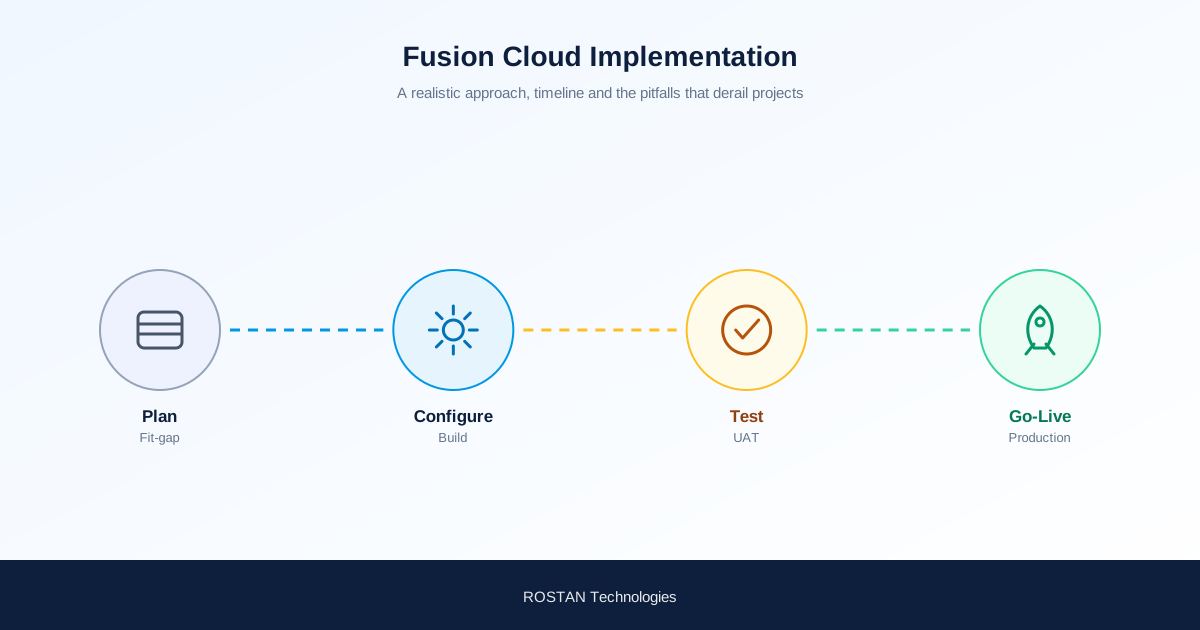
- Plan & strategy — scope, pillars, target processes, and the business case.
- Configure & prototype — set up in Functional Setup Manager, validate against real business scenarios in iterative conference-room pilots.
- Data migration — the part that most often overruns; extract, cleanse and reconcile legacy data early and repeatedly.
- Test — including integrations, reports, and at least one full end-to-end cycle.
- Go-live & support — cutover, hypercare, then settle into the quarterly-update rhythm.
The three pitfalls that sink Fusion programmes: under-estimating data migration, over-customizing to mirror the old system, and treating change management as an afterthought. None of them is a technology problem.
Data and change decide the outcome
Clean data and a workforce ready to work the new way matter more than any configuration choice. Start data cleansing before you think you need to, and involve the people who will use the system from the first pilot — not at training week.
Planning a Fusion Cloud implementation?
We run Fusion programmes that configure rather than customize, treat data migration as the real work, and put change management first — the three things that decide success.
Talk to a Fusion Consultant
Related service
Oracle Fusion Cloud & EBS
We implement Oracle Fusion Cloud and support Oracle E-Business Suite. If someone is telling you EBS is end-of-life, read this first — Oracle has committed Premier Support through at least 2037.
See our Oracle ERP services
Frequently Asked Questions
It varies with scope, the number of pillars, data complexity and organisational readiness rather than a fixed number. A single-pillar, standard-process rollout is far quicker than a multi-pillar global programme. The reliable way to get a timeline is a scoping assessment; beware anyone quoting a duration before understanding your data and processes.
Minimise it. Fusion is designed to be configured through its Functional Setup Manager, not modified. Forcing Fusion to mirror an old on-premises system re-creates the customization burden you were escaping and fights the mandatory quarterly updates. Adopt standard processes where you can and extend only for genuine competitive differentiation.
Three recurring, non-technical reasons: under-estimating data migration, over-customizing to replicate the legacy system, and treating change management as an afterthought. Clean data and a prepared workforce matter more to the outcome than any single configuration decision.
Functional Setup Manager (FSM) is the tool used to configure Oracle Fusion Cloud Applications — defining and managing the setup tasks for each module in a structured, repeatable way. It is the intended path for tailoring Fusion to your business through configuration rather than code.

Written & reviewed by
Vice President — Oracle Delivery, ROSTAN Technologies
Rajkumar Awasthi leads Oracle delivery at ROSTAN Technologies, overseeing Oracle ERP implementation, Oracle E-Business Suite support and EBS-to-Fusion Cloud migration engagements for enterprise customers across India and the GCC.
More from Rajkumar →
Free · No obligation · 48-hour report
Get a free Oracle Health Check
Our Oracle Gold Partner experts review your EBS, Fusion Cloud or APEX environment and send a written report on performance gaps, cost savings and upgrade risk.
Have questions about Oracle, AWS or Cloud?
Talk to our certified experts — free consultation, no commitment.