Oracle Fusion Financials Accounts Payable: More Than Just Invoice Processing
Many organizations still view Accounts Payable as a back-office function. In Oracle Fusion Financials, AP is built to be a strategic enabler for financial control, compliance, and operational efficiency.
Why AP Deserves a Second Look
Accounts Payable touches nearly every part of the finance function — cash flow, supplier relationships, audit readiness, and working capital. When AP runs on manual processes and disconnected spreadsheets, all of that becomes reactive: invoices get processed late, exceptions pile up, and finance teams spend more time chasing paperwork than managing cash. Oracle Fusion Financials rebuilds AP around automation and visibility, so it can function as a control point rather than a bottleneck.
The AP_INVOICES_ALL Table: Where It Starts
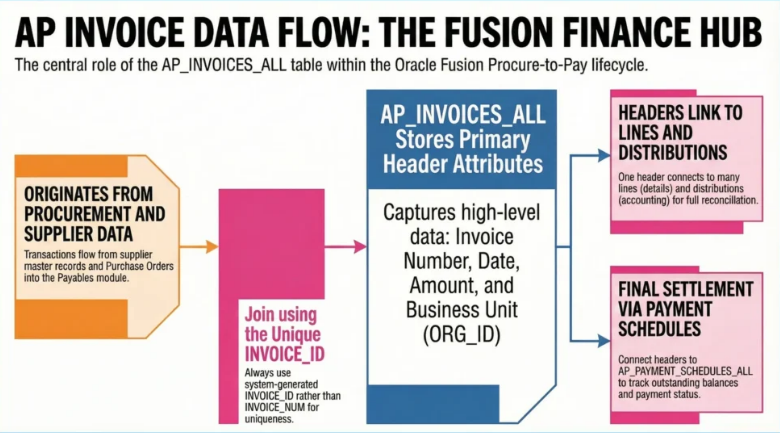
Every invoice in Oracle Fusion Payables ultimately traces back to the AP_INVOICES_ALL table, which stores the primary header attributes for each invoice — invoice number, date, amount, and business unit (ORG_ID). Transactions flow into it from supplier master records and Purchase Orders originating in Procurement, and it connects outward in two directions: headers link to invoice lines and distributions for full accounting reconciliation, and headers connect to AP_PAYMENT_SCHEDULES_ALL to track outstanding balances and payment status through to final settlement. The one detail worth remembering if you ever write custom reports or integrations against this table: always join using the system-generated INVOICE_ID, not INVOICE_NUM — the invoice number is supplier-provided and not guaranteed unique, while INVOICE_ID is.
What Oracle Fusion AP Actually Delivers
- Automated invoice capture and intelligent validation — invoices are captured and checked against business rules before they ever reach a human approver.
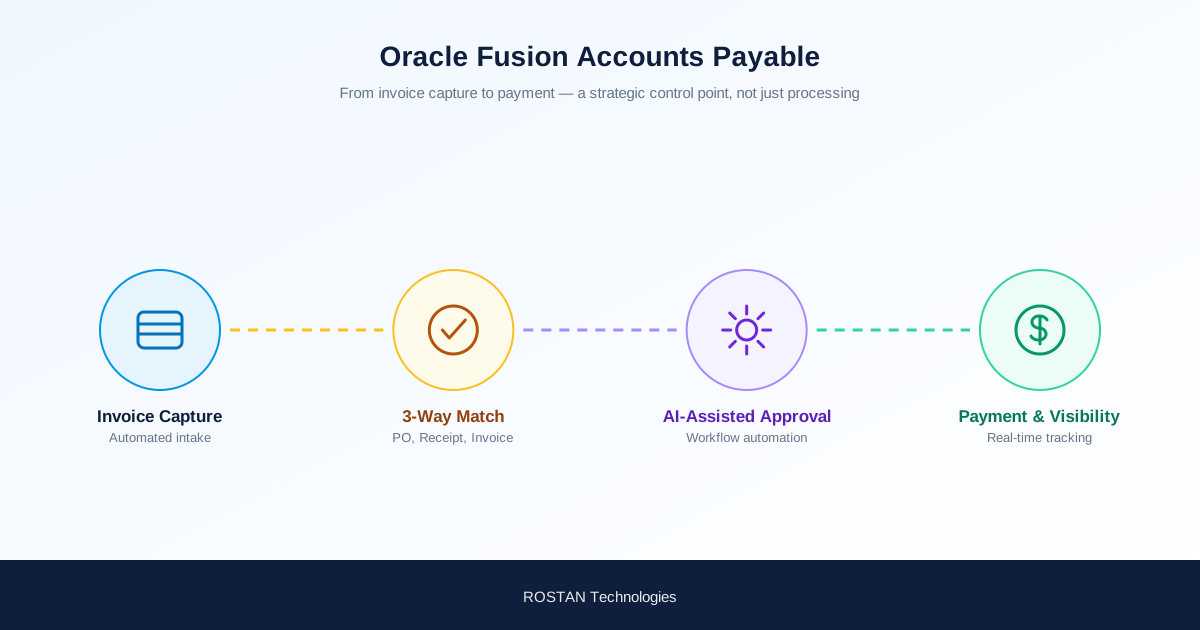
- Three-way matching (PO, Receipt & Invoice) — the system reconciles what was ordered, what was received, and what was billed before releasing payment.
- AI-assisted invoice approvals and workflow automation — routine invoices move through approval workflows automatically, with exceptions routed for review.
- Supplier self-service and streamlined collaboration — suppliers can check invoice and payment status directly, cutting down status-check emails and calls.
- Real-time payment tracking and cash flow visibility — finance teams see outstanding liabilities and payment timing as they happen, not at month-end.
- Built-in compliance, audit trails, and analytics — every action on an invoice is logged, which matters as much for internal audit as for external regulatory review.
The Result
| Capability | Business Outcome |
|---|---|
| Automated capture & three-way match | Faster invoice processing |
| AI-assisted approvals | Reduced manual intervention |
| Supplier self-service | Improved supplier relationships |
| Audit trails & analytics | Stronger financial governance |
| Real-time payment tracking | Better working capital management |
In today's digital finance landscape, an efficient Accounts Payable function is no longer a competitive advantage — it's a business necessity.
How ROSTAN Helps
As an Oracle Gold Partner, ROSTAN implements and optimizes Oracle Fusion Financials Accounts Payable for enterprises moving off manual processes or legacy ERP — configuring invoice automation, matching rules, approval workflows, and supplier self-service to fit how your finance team actually operates, then supporting the environment as it scales.
Frequently Asked Questions
What is the AP_INVOICES_ALL table used for?
It stores the primary header-level attributes of every invoice in Oracle Fusion Payables — invoice number, date, amount, and business unit — and is the central reference point that invoice lines, distributions, and payment schedules all connect back to.
Why join on INVOICE_ID instead of INVOICE_NUM?
INVOICE_NUM is the supplier-provided invoice number and is not guaranteed to be unique across suppliers or business units. INVOICE_ID is the system-generated unique identifier, so it is the reliable join key for reports and integrations.
What is three-way matching in Oracle Fusion AP?
It is the automated reconciliation of three documents — the Purchase Order, the Receipt, and the Invoice — before a payment is released, ensuring the business only pays for what was ordered and actually received.
Does Oracle Fusion AP support supplier self-service?
Yes. Suppliers can check invoice status and payment status directly through self-service access, reducing the volume of manual status-check communication with the AP team.
Conclusion
Treating Accounts Payable as pure back-office processing leaves real value on the table — faster cycle times, stronger supplier relationships, and better cash visibility. Oracle Fusion Financials is built to make AP a strategic control point instead, and that starts with understanding how the data actually flows, from invoice capture through to final payment settlement.
Looking to modernize your Accounts Payable process? Talk to ROSTAN about Oracle Fusion Financials.