Oman e-Invoicing Integration Solution: Future-Ready ERP Integration via PEPPOL
Oman is the third GCC country, after Saudi Arabia and the UAE, to mandate e-Invoicing. The Oman Tax Authority (OTA) was approved as a Peppol Authority in January 2026, formally adopting the Peppol framework as the backbone of Oman's national e-invoicing system, Fawtara. Phase 1 begins in August 2026 — businesses need ERP-integrated, compliant invoicing in place well before then.
At ROSTAN Technologies, we help organizations integrate Oracle, SAP, Microsoft Dynamics, Odoo and other ERP platforms with certified Access Service Providers (ASP) through the PEPPOL network, so invoices exchange securely and report correctly to the Oman Tax Authority under Fawtara.
What is Fawtara, Oman's e-Invoicing system?
Fawtara is Oman's national e-invoicing system, built on the PEPPOL five-corner model. Rather than routing every invoice through a single central government portal, invoices are exchanged through OTA-accredited Access Service Providers under Oman Tax Authority supervision — a decentralized model designed for real-time validation, interoperability and security.
Invoices are created in an accounting or ERP system and transmitted electronically as XML (UBL 2.1) or PDF/A-3, aligned with the PINT Oman specification, rather than as scanned or emailed PDFs.
Oman e-Invoicing rollout timeline
The OTA mandate is phased by taxpayer size, not applied to every VAT-registered business on day one:
- Phase 1 — August 2026: 144 large VAT-registered taxpayers already notified by the OTA
- Phase 2 — February 2027: all large VAT-registered companies
- Phase 3 — August 2027: all remaining VAT-registered taxpayers
Phase 1 is only weeks away at the time of writing. Even businesses in Phase 2 or 3 should not wait — ASP onboarding, ERP integration and testing all take real lead time.
Solution highlights
Oman e-Invoicing process
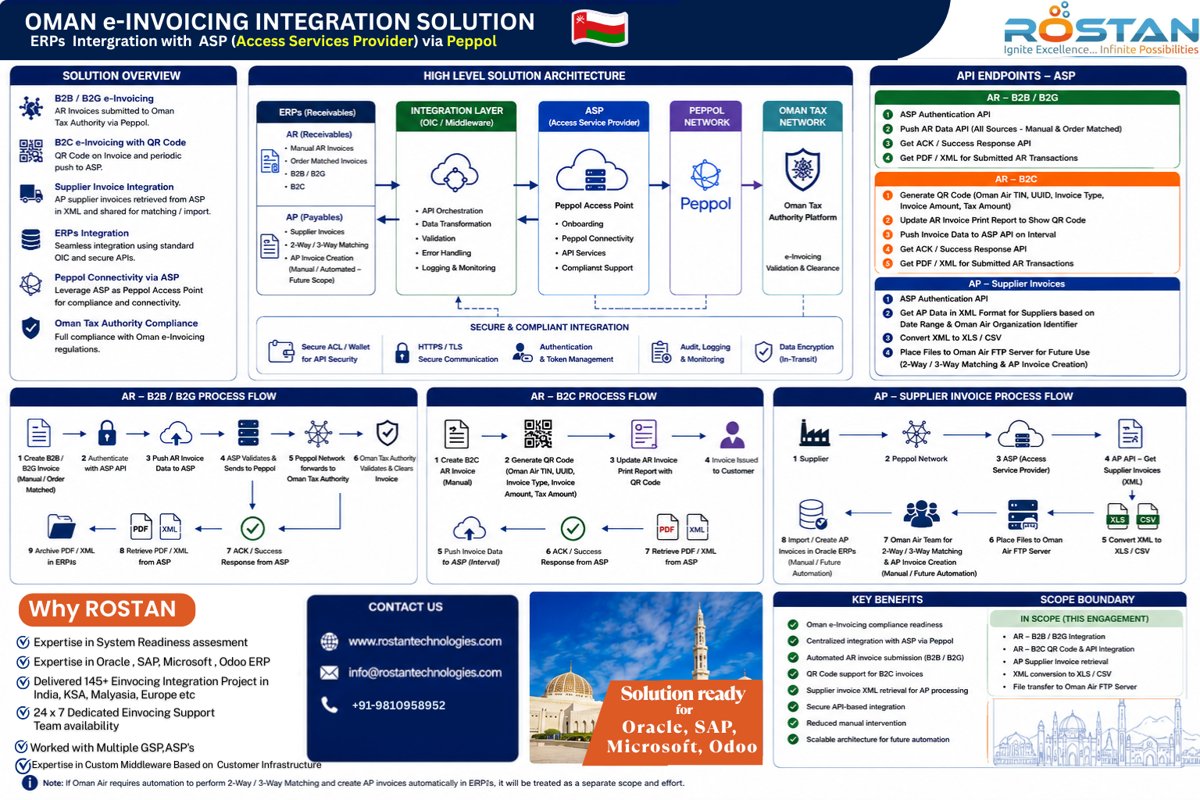
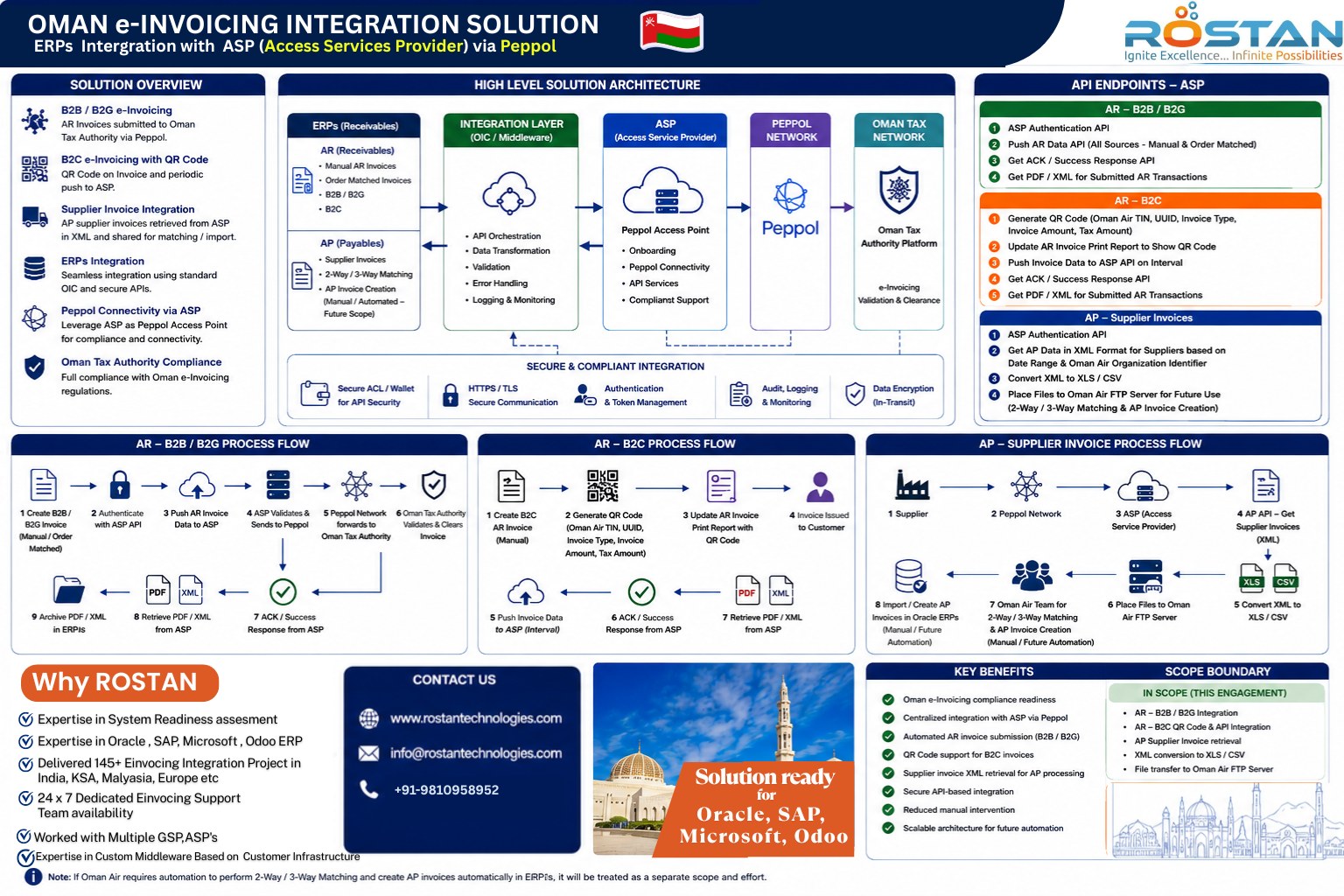
AR — B2B / B2G: create invoice in ERP, authenticate with the ASP API, push AR invoice data, the ASP validates and forwards it through the PEPPOL network, the Oman Tax Authority validates and clears it, and the ERP retrieves the ACK plus the PDF/XML for archiving.
AR — B2C: create the invoice, generate a QR code (TIN, UUID, invoice type, amount and tax), print the invoice with the QR code, issue it to the customer, then push the invoice data to the ASP on an interval and retrieve the ACK and PDF/XML.
AP — supplier invoices: the ASP retrieves supplier invoices in XML from the PEPPOL network, converts them to XLS/CSV, and the files are made available for import or automated AP invoice creation in the ERP.
ERP platforms supported
ROSTAN Technologies provides Oman e-Invoicing integration for:
- Oracle Fusion Cloud
- Oracle E-Business Suite
- Oracle NetSuite
- SAP S/4HANA
- Microsoft Dynamics 365
- Odoo
- Custom ERP applications
Why choose ROSTAN Technologies?
- 145+ successful e-Invoicing integration projects
- Expertise across Oracle, SAP, Microsoft and Odoo ERP
- Dedicated integration and compliance team
- Secure, scalable and future-ready architecture
- End-to-end support from assessment to go-live
- 24x7 dedicated e-invoicing support
Whether you're preparing for B2B, B2C or AP invoice automation, our solution simplifies compliance while reducing manual effort and improving operational efficiency.
Getting Ready for Fawtara — Phase 1 Has Begun
Phase 1 began in August 2026 for the 144 large VAT-registered companies already notified by the OTA — if your business is in that group and not yet integrated, treat this as urgent. Phase 2 follows in February 2027 for all large taxpayers; businesses expecting to be in scope should assess ERP readiness, confirm ASP onboarding requirements, and begin PEPPOL connectivity testing now rather than waiting for formal notification.
Related reading: Oman follows the same PEPPOL family of standards as its GCC neighbours — see our UAE e-Invoicing PEPPOL compliance guide and ZATCA Phase 2 compliance checklist for how the neighbouring mandates compare. For the Oracle-side connection mechanics, see our Oracle Fusion Cloud e-invoicing integration guide.
Partner with ROSTAN Technologies
ROSTAN Technologies delivers end-to-end Oman e-Invoicing solutions — from ERP readiness assessment and ASP/PEPPOL connectivity to QR code generation, AP invoice automation, testing, go-live and ongoing support. Whether you use Oracle, SAP, Microsoft Dynamics, Odoo or a custom ERP, our experts can help you meet the OTA Fawtara mandate on time.
Talk to Our Oman e-Invoicing Team