Procure-to-Pay (P2P): The Complete Process, Step by Step
Procure-to-Pay is the integrated business process of acquiring goods or services — spanning from initial need identification and purchasing to supplier payment and accounting.
What Is P2P?
P2P is a process, not a technology. It can be run manually, but most organizations implement it as an automated process using ERP and other software solutions to streamline and integrate its various stages. Automation in P2P enhances efficiency by reducing manual tasks, minimizing errors, ensuring compliance with policies, and providing real-time visibility into procurement activities. While many organizations implement automated P2P systems to optimize their operations, the degree of automation varies depending on the specific tools and practices in place.
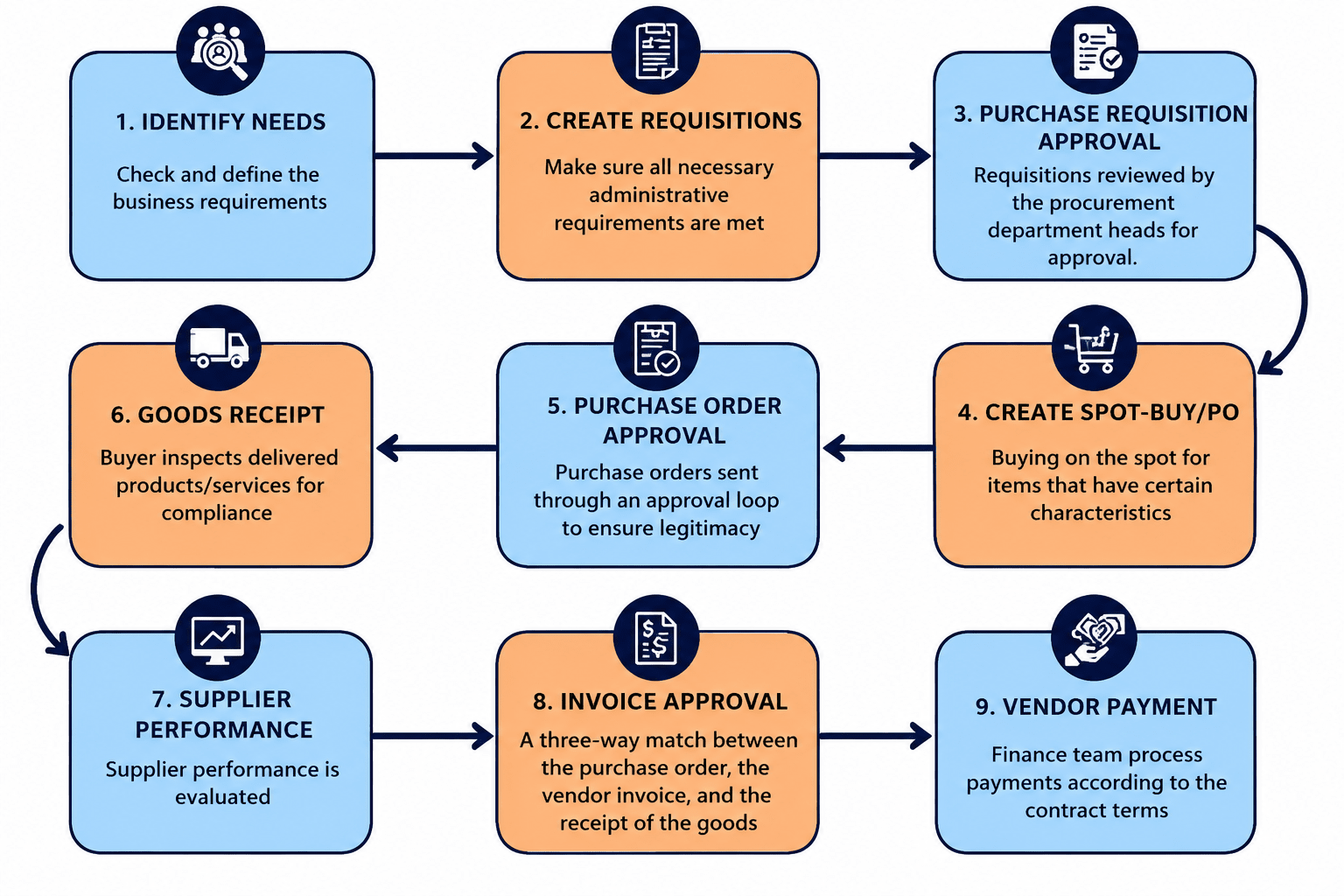
The P2P Workflow: Nine Steps

Request
The process starts when a department in the company needs a product or service. A purchase request is created, the manager reviews and approves it, and budget and quantity are added.
Source
The company searches for the best supplier or vendor. Vendors are identified, quotations are collected, prices and quality are compared, and the best supplier is selected.
Receive
After supplier selection, goods or services are delivered to the company. The supplier sends the items, the company checks quantity and quality, and a Goods Receipt Note (GRN) is created.
Process Invoice
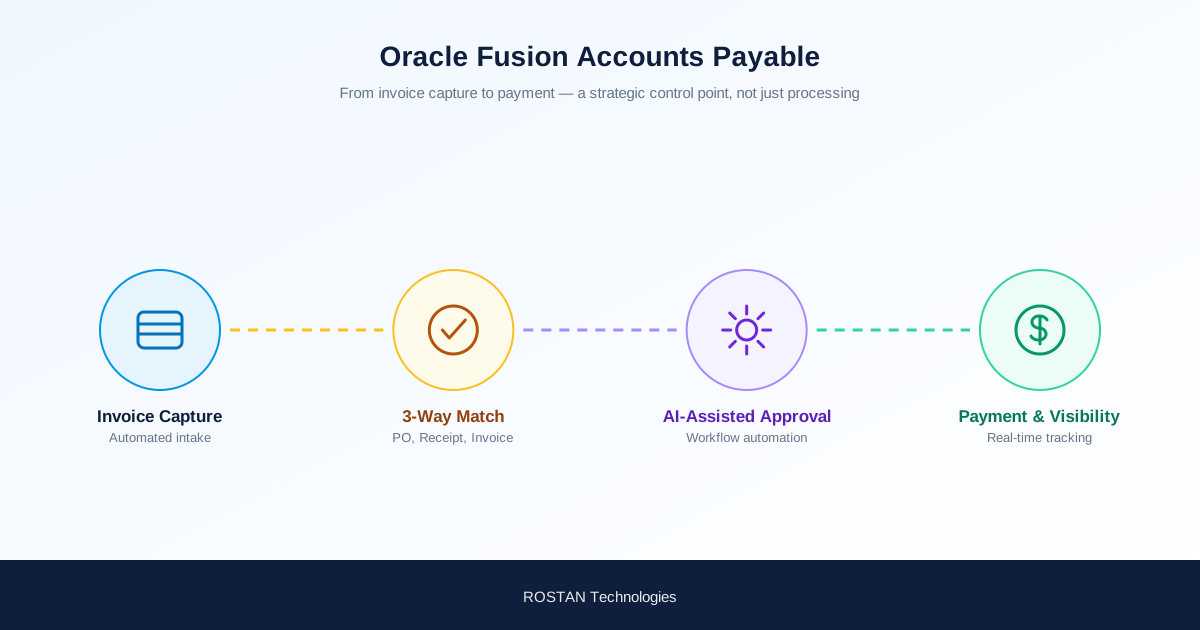
The supplier sends an invoice for payment. The invoice is verified and matched against the Purchase Order (PO) and Goods Receipt (GRN), and any errors or mismatches are checked before proceeding.
Pay
After invoice approval, payment is made to the supplier. The finance team processes payment through bank transfer, cheque, or online methods, and the transaction is recorded in the accounting system.
Request Approval Workflow
Once raised, a request follows a predefined approval path based on department hierarchy, value threshold, budget availability, and item criticality. This ensures control, accountability, and budget discipline throughout the process.
| Stage | What Happens |
|---|---|
| Request created | By the user department, based on identified business need. |
| Request reviewed & approved | Checked against department hierarchy, value threshold and budget. |
| Order created | By the procurement team, referencing the approved request. |
| Order shared with supplier | Purchase order transmitted for fulfillment. |
| Acknowledgement & delivery | Often automated via ERP/procurement tools such as SAP, Oracle, Zoho, or Coupa. |
Best Practices for Error-Free Request to Order
- Always validate specifications and quantity before submitting a request.
- Don't bypass request approvals, even under time pressure.
- Match every request against available budget before it proceeds.
- Keep supplier master data updated and accurate.
- Automate wherever possible, especially approvals.
Avoid shortcuts — they lead to maverick spend and audit flags.
Benefits of a Well-Run P2P Process
- Better cost control — spend is visible and approved before it happens, not discovered after the fact.
- Faster approvals — a defined, automated approval path removes bottlenecks.
- Reduced paperwork — documents move through the system instead of across desks.
- Improved vendor management — consistent processes make supplier performance easier to track and evaluate.
How ROSTAN Helps
As an Oracle Gold Partner, ROSTAN designs and implements Procure-to-Pay workflows on Oracle Fusion Cloud and Oracle E-Business Suite — from requisition and approval routing to three-way matching and vendor payment — configured around your actual approval hierarchy and budget controls, not a generic template.
Frequently Asked Questions
What does P2P stand for?
P2P stands for Procure-to-Pay — the end-to-end process of acquiring goods or services, from identifying a need through to paying the supplier and recording the transaction in accounting.
What is a three-way match in P2P?
A three-way match reconciles three documents before payment is approved: the Purchase Order, the Goods Receipt (GRN), and the supplier's Invoice. This ensures a business only pays for what was ordered and actually received.
What determines a request's approval path in P2P?
Approval paths are typically driven by department hierarchy, the value threshold of the request, budget availability, and how critical the item is to operations.
Is P2P specific to one ERP platform?
No. P2P is a business process, not a technology. It is commonly automated using ERP and procurement platforms such as SAP, Oracle, Zoho, or Coupa, but the underlying process — request, source, receive, process invoice, pay — remains the same.
Conclusion
A well-run Procure-to-Pay process turns procurement from a source of maverick spend and audit risk into a source of cost control and vendor accountability. The mechanics are straightforward — request, source, receive, process invoice, pay — but the discipline of validating specifications, respecting approval hierarchies, and matching against budget at every stage is what actually makes it work.
Looking to streamline your Procure-to-Pay process? Talk to ROSTAN about Oracle Procurement and P2P automation.