Oracle Cloud ERP Managed Services: Keeping the System You Invested In Running at Its Best
Going live on Oracle Cloud ERP is the start, not the finish. Managed services are what keep it stable, compliant, and improving after go-live. Here is what they include, how support tiers work, and the best practices that separate a good managed-services partner from a costly one.
What Are Oracle ERP Cloud Managed Services?
Oracle ERP cloud managed services are the ongoing operations, support, and enhancement of your Oracle Fusion Cloud or Oracle E-Business Suite environment after implementation. Instead of relying on a stretched internal team, you hand day-to-day support, issue resolution, quarterly-update readiness, and continuous improvement to a partner with dedicated Oracle expertise. The goal is simple: maximise the value of the ERP you already paid to implement, while freeing your internal staff to focus on the business rather than firefighting tickets.
Key Insight: The biggest hidden cost of Oracle Cloud is not the licence. It is what happens when quarterly updates, regulatory changes, and unaddressed enhancement requests pile up. Good managed services turn that backlog into a managed, predictable cadence.
What Managed Services Should Include
- Incident & service-request support — resolving user issues and break-fix tickets against agreed SLAs.
- Quarterly update management — testing and adopting Oracle Fusion's mandatory quarterly releases without disrupting the business.
- Regulatory & statutory updates — keeping tax, e-invoicing, and compliance configurations current as rules change.
- Enhancements & minor projects — delivering new reports, workflows, and configuration changes as the business evolves.
- Integration & interface monitoring — watching the connections between ERP and other systems so failures are caught early.
- Period-end & year-end support — extra hands and expertise during financial close.
- Proactive monitoring & health checks — finding problems before users report them.
Understanding L1, L2, and L3 Support Tiers
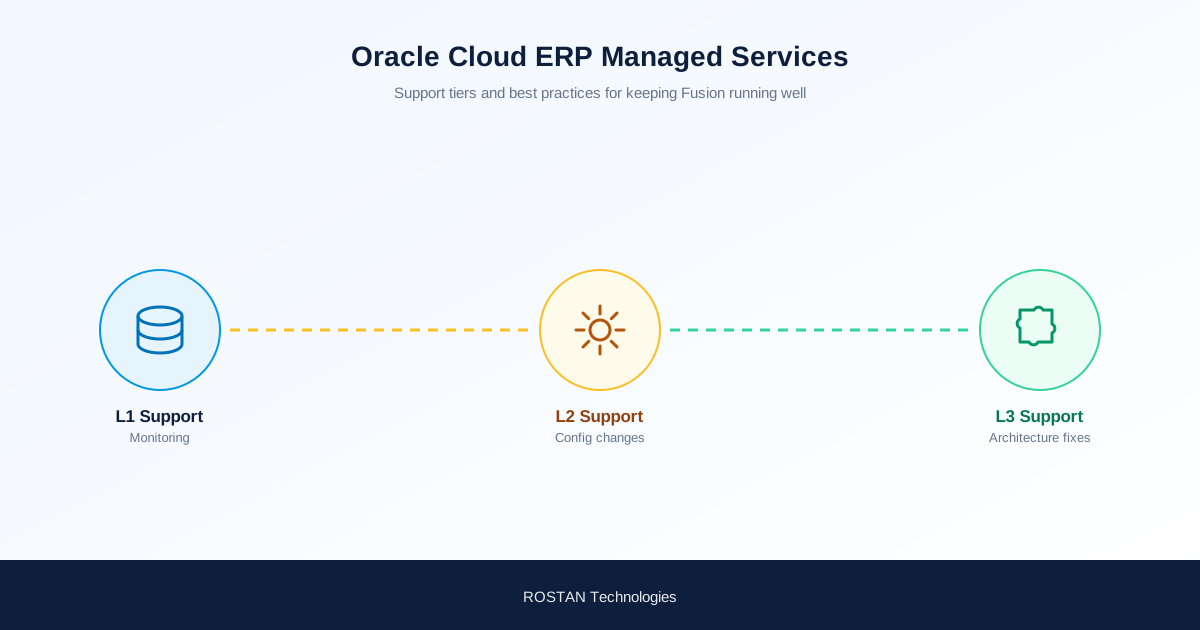
Mature Oracle ERP cloud managed services are organised into three tiers, so the right skill level handles each issue and you do not pay senior-consultant rates for password resets.
| Tier | Handles |
|---|---|
| L1 — Service desk | User queries, access, basic how-to, ticket triage and routing. |
| L2 — Functional/technical | Configuration changes, report fixes, workflow issues, data corrections. |
| L3 — Specialist/engineering | Complex defects, integrations, customisation remediation, Oracle SR coordination. |
Oracle ERP Best Practices for Managed Services
Whether you run support in-house or through a partner, these Oracle ERP best practices keep the environment healthy and the cost predictable:
- Treat quarterly updates as routine, not events — maintain a regression test pack so each Fusion update is a controlled, repeatable process.
- Minimise and document customisations — every extension is something to test on each update, so keep them lean and well-documented.
- Use a single backlog — track incidents, enhancements, and update tasks in one place so nothing falls through the cracks.
- Define SLAs by business impact — a stuck financial close is not the same priority as a cosmetic report tweak.
- Build a knowledge base — capture recurring fixes so they are resolved faster and the service improves over time.
- Review quarterly — measure SLA performance, ticket trends, and enhancement throughput, and adjust.
When to consider managed services: if your internal team spends more time on support tickets than improvement, if quarterly updates feel risky, or if compliance changes catch you unprepared, a managed-services model usually pays for itself in stability and freed-up time.
How ROSTAN Delivers Oracle ERP Cloud Managed Services
As an Oracle Gold Partner, ROSTAN Technologies provides Oracle ERP cloud managed services for both Oracle Fusion Cloud and Oracle E-Business Suite, with L1/L2/L3 tiers, SLA-backed support, quarterly-update management, statutory and e-invoicing compliance, and a single transparent backlog. Our model is built to reduce ticket volume over time through proactive monitoring and a growing knowledge base, so the service gets better and more cost-effective the longer it runs.
Conclusion
Oracle Cloud ERP rewards the organisations that operate it well after go-live. Managed services — done with clear support tiers, disciplined quarterly-update handling, and the best practices above — protect your investment, keep you compliant, and let your team focus on the business instead of the backlog. Choose a partner who reduces your ticket volume over time, not one who simply bills for it.
Want predictable Oracle ERP support? Talk to ROSTAN about Oracle Cloud ERP managed services.