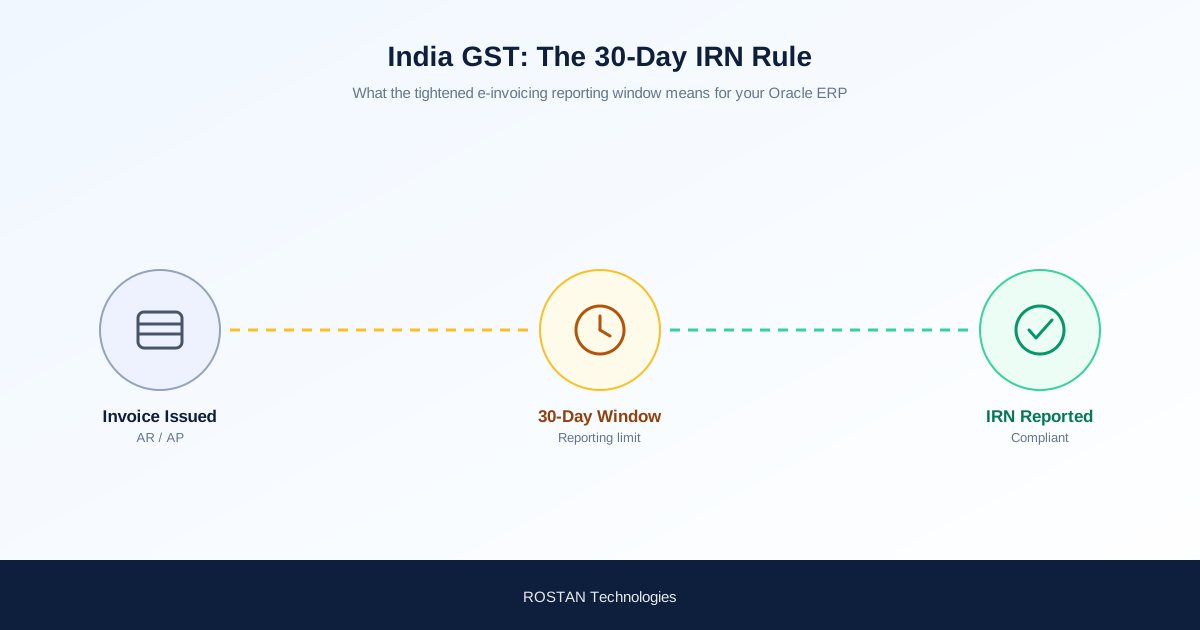
India GST E-Invoicing in 2026: The 30-Day Reporting Rule and What Your Oracle ERP Must Enforce
Indian GST e-invoicing is no longer just about generating an IRN. Since 1 April 2025 the Invoice Registration Portal actively rejects invoices reported late, and the turnover net keeps widening. If your finance team runs Oracle, the controls now belong inside the ERP — not in a spreadsheet next to it.
E-invoicing under GST is governed by Rule 48(4) of the CGST Rules. In-scope businesses must report every B2B invoice, export invoice, credit note and debit note to a government-approved Invoice Registration Portal (IRP), which returns a signed Invoice Reference Number (IRN) and a digitally signed QR code. Only an invoice carrying a valid IRN is legally valid for the recipient to claim input tax credit. What changed in 2025 is not the mechanism but the discipline the portal now enforces around it.
The turnover threshold has fallen to ₹5 crore
The mandate has expanded in steps since it began. Each reduction pulled a new band of mid-market companies into scope:
Oct 2020
AATO above ₹500 crore
Jan 2021
Above ₹100 crore
Apr 2021 – Oct 2022
₹50cr, then ₹20cr, then ₹10cr
1 Aug 2023
Above ₹5 crore — current threshold
The test is aggregate annual turnover (AATO) in any financial year since 2017–18, not just the current one. A company that briefly crossed ₹5 crore in an earlier year stays in scope even if it has since shrunk. This trips up finance teams who assume last year's numbers decide today's obligation.
The 30-day reporting rule now blocks late IRNs
The most consequential recent change is a hard time limit. Following the GSTN advisory of 5 November 2024, from 1 April 2025 any taxpayer with an AATO of ₹10 crore and above must report a document to the IRP within 30 days of the document date. This applies to invoices, credit notes and debit notes alike.
Key change: the IRP does not warn — it refuses. Attempt to register an invoice dated more than 30 days ago and the portal returns an error and will not issue an IRN. Without an IRN the document is not a valid tax invoice, so your customer cannot take input tax credit against it.
The earlier version of this rule applied only to businesses above ₹100 crore (from November 2023). Lowering it to ₹10 crore brought a far larger population of Oracle-run enterprises into a regime where a backdated or delayed invoice is not a reconciliation headache later — it is a document that can never be registered at all.
Six IRPs, one IRN
India no longer has a single portal. The original NIC IRP (einvoice1) has been joined by additional government-authorised private IRPs. A business may register invoices through any authorised IRP; the IRN is unique across all of them, so the same invoice cannot be registered twice. For an Oracle estate this means the integration target is a choice, not a given — and your GST Suvidha Provider (GSP) or Application Service Provider (ASP) usually abstracts which IRP is used behind a single API.
What this means inside Oracle Fusion and EBS
Generating the IRN is the easy 80%. The controls that keep you compliant are the harder 20%, and they belong in the ERP where the invoice is born:
- Register at the right moment. Whether you clear the invoice at the point of AR completion or in a scheduled batch, the design must guarantee no document drifts toward the 30-day wall unreported. A batch that runs weekly is fine; a batch that silently skips errored invoices is not.
- Store the full response. Persist the IRN, the acknowledgement number, the acknowledgement date and the signed QR against the AR transaction. These are audit artefacts, not display fields — they must survive archival.
- Print the signed QR. The government QR (not a self-generated one) must appear on the invoice PDF the customer receives. In Oracle BI Publisher this is a template change plus a data-model field for the base64 QR string.
- Guard the 30-day window. Build an exception report that flags any in-scope, unregistered document approaching day 30. This is the single control most Oracle customers discover they are missing only after an invoice becomes unregisterable.
- Handle credit and debit notes the same way. They carry the same IRN obligation and the same 30-day clock — a common gap when only sales invoices were wired up.
- Reconcile e-invoice with GSTR-1 and the e-way bill. A registered e-invoice auto-populates GSTR-1 and can auto-generate Part-A of the e-way bill. Treat the IRP as the source of truth and reconcile the ERP against it, not the reverse.
Related reading: for the connection mechanics — IRP APIs, IRN generation and QR handling in Oracle Fusion — see our Oracle Fusion Cloud e-invoicing integration guide. For the signing layer, see digital signature integration with Oracle ERP. To see where India's clearance model sits among global approaches, read our comparison of clearance versus post-audit e-invoicing models.
A practical readiness check for Oracle finance teams
- Confirm scope honestly. Check AATO across every year since 2017–18, not just the latest — the ₹5 crore trigger is sticky.
- Find your slowest invoice. Measure the real lag between invoice date and IRP reporting today. If any category regularly exceeds two weeks, the 30-day rule is a live risk.
- Instrument the exception report. Nothing in-scope should be able to reach day 25 unregistered without someone being alerted.
- Verify the QR is the government's. Confirm the printed QR is the signed IRP response, not a locally generated code.
- Test credit/debit notes end to end. Register, store, print and reconcile them exactly as invoices.
Is your Oracle ERP enforcing the 30-day rule — or just generating IRNs?
ROSTAN Technologies implements and hardens GST e-invoicing on Oracle Fusion Cloud and E-Business Suite — IRP integration, QR on BI Publisher output, and the exception controls that keep documents from ageing past the reporting window. Get a compliance readiness review of your current setup.
Book a GST E-Invoicing Review