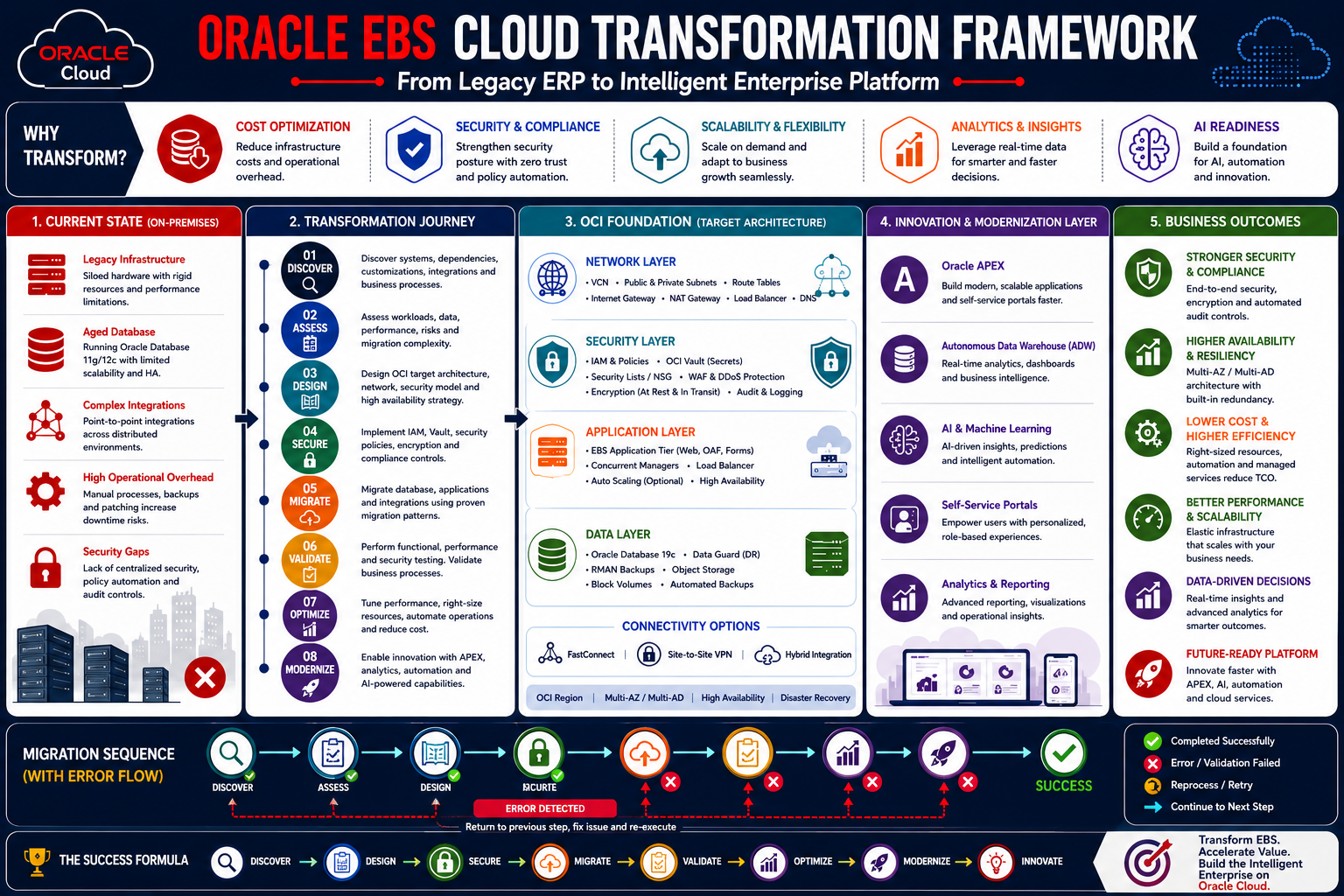
The Hidden Realities of Migrating Oracle EBS to OCI
In enterprise transformation, "lift and shift" is often sold as a guarantee of a seamless transition where legacy systems simply wake up in a modern environment. In practice, success is not measured by the elegance of an architecture slide; it is measured by the gap between projected downtime and actual operational continuity. Moving Oracle E-Business Suite (EBS) to Oracle Cloud Infrastructure (OCI) is a sophisticated architectural evolution, not a push-button move. To modernise, secure, and optimise effectively, you have to look past the clean diagrams and deal with the hard technical truths of data integrity, network security, and total cost of ownership.
Takeaway 1: Connectivity Is Often the Silent Project Killer
In the move from an on-premises environment to an OCI Virtual Cloud Network (VCN), connectivity is frequently the first point of failure. Diagrams show a clean bridge over Site-to-Site VPN or FastConnect, but in reality incomplete Network Security Group (NSG) rules and misconfigured edge components can stall a migration for weeks.
This silent project killer usually comes from missing documentation of legacy traffic flows. Over years, on-premises EBS environments accumulate undocumented integrations and complex inter-tier communication. If you have not validated every flow, from the public load balancer over HTTPS through to the private subnets that host your application and database tiers, you are effectively flying blind. The mitigation is simple to state and demanding to do: document every flow and validate it early in the project so that security rules never become the bottleneck at cutover.
Takeaway 2: The "In-Flight" Data Trap
Data validation gaps are a high-stakes risk for any financial system. When the EBS schema is migrated, reporting mismatches often appear because of in-flight data, transactions that hit the source system after the initial export has already begun.
The standard approach relies on Data Pump, and it is essential to remember that this is a point-in-time operation, not real-time replication. Without a rigorous strategy for the delta between source and target, data integrity is compromised. The answer is to implement freeze periods and checkpoints. These freeze windows are non-negotiable: they give Data Pump the clean slate it needs so the OCI environment becomes a perfect mirror of the source, and they prevent the costly reconciliation work that haunts poorly planned migrations.
Takeaway 3: Performance Gains Are Not Always Automatic
A common executive assumption is that moving to OCI's high-performance infrastructure will automatically solve every latency problem. The reality is more nuanced. OCI provides a superior foundation of IOPS and compute, but not all workloads improve the moment they land.
Legacy queries that were "good enough" on-premises can behave differently in a modern, tiered cloud architecture. Realising the full performance potential of the cloud requires a deliberate post-migration stance: tune queries, optimise database parameters, and validate performance against your existing benchmarks. The cloud provides the engine, but the legacy code still needs a tune-up to run well on Oracle Database 19c.
Takeaway 4: The HCC Assessment Is a Prerequisite You Cannot Skip
One of the most critical technical hurdles in moving from Oracle Database 11g or 12c to 19c on OCI is the Hybrid Columnar Compression (HCC) assessment. Skipping it is a primary driver of unexpected storage growth and post-migration performance problems. To protect architectural integrity and manage storage cost, complete the following before the final move:
- Evaluate HCC-enabled objects to identify compatibility or expansion issues.
- Assess storage growth expectations specifically for the 19c target environment.
- Test export and import performance to refine the cutover window.
- Rebuild or reorganise objects where required so they are optimised for OCI storage.
- Gather fresh optimizer statistics immediately after migration so the 19c engine has the best execution plans.
Takeaway 5: Migration Is an Upgrade, Not Just a Move
A successful migration should be treated as a full modernisation of the EBS stack. By moving the EBS schema to Oracle Database 19c and placing both the application and database tiers in private subnets, organisations move from a posture of maintenance to one of innovation. The transition is defined by adopting a comprehensive OCI managed-services stack that delivers governance and visibility that legacy data centres cannot match:
- Operational visibility: real-time insight through OCI Logging, Monitoring, and Notifications and Alarms.
- Enhanced security: strong access control and secret management via IAM, OCI Bastion, and OCI Vault.
- Strategic scalability: high-availability configurations with Data Guard and automated RMAN backups to Object Storage.
- Future-proofing: a direct integration path to the Autonomous Data Warehouse for advanced analytics and to Oracle APEX for modern low-code application development.
Conclusion: Moving Toward a Modernised Future
The transition of Oracle EBS to OCI is the ultimate test of an organisation's operational readiness. It requires shifting from a setup mindset to a modernisation mindset, where the goal is not just to be live, but to be modernised, secured, and optimised. The journey does not end at cutover. Post-migration support, continuous tuning, and validation are where the real value of the cloud is solidified. The honest question for IT leaders is this: is your organisation prepared to enforce the necessary freeze periods and commit to the rigorous query tuning required to truly unlock OCI, or are you still betting on the lift-and-shift myth?
Planning an Oracle EBS to OCI migration?
ROSTAN Technologies is an Oracle Gold Partner. We help enterprises across India and the Middle East migrate Oracle EBS to OCI with disciplined network validation, freeze-period data strategies, HCC assessments, and post-migration tuning. Download the detailed guides below or talk to our migration team.
Book a Free ConsultationMoving Oracle EBS to OCI? ROSTAN's Oracle EBS to OCI migration services cover assessment, CEMLI and PL/SQL remediation, GST localisation and zero-downtime cutover. See also the step-by-step EBS-to-OCI migration roadmap and EBS disaster recovery on OCI.