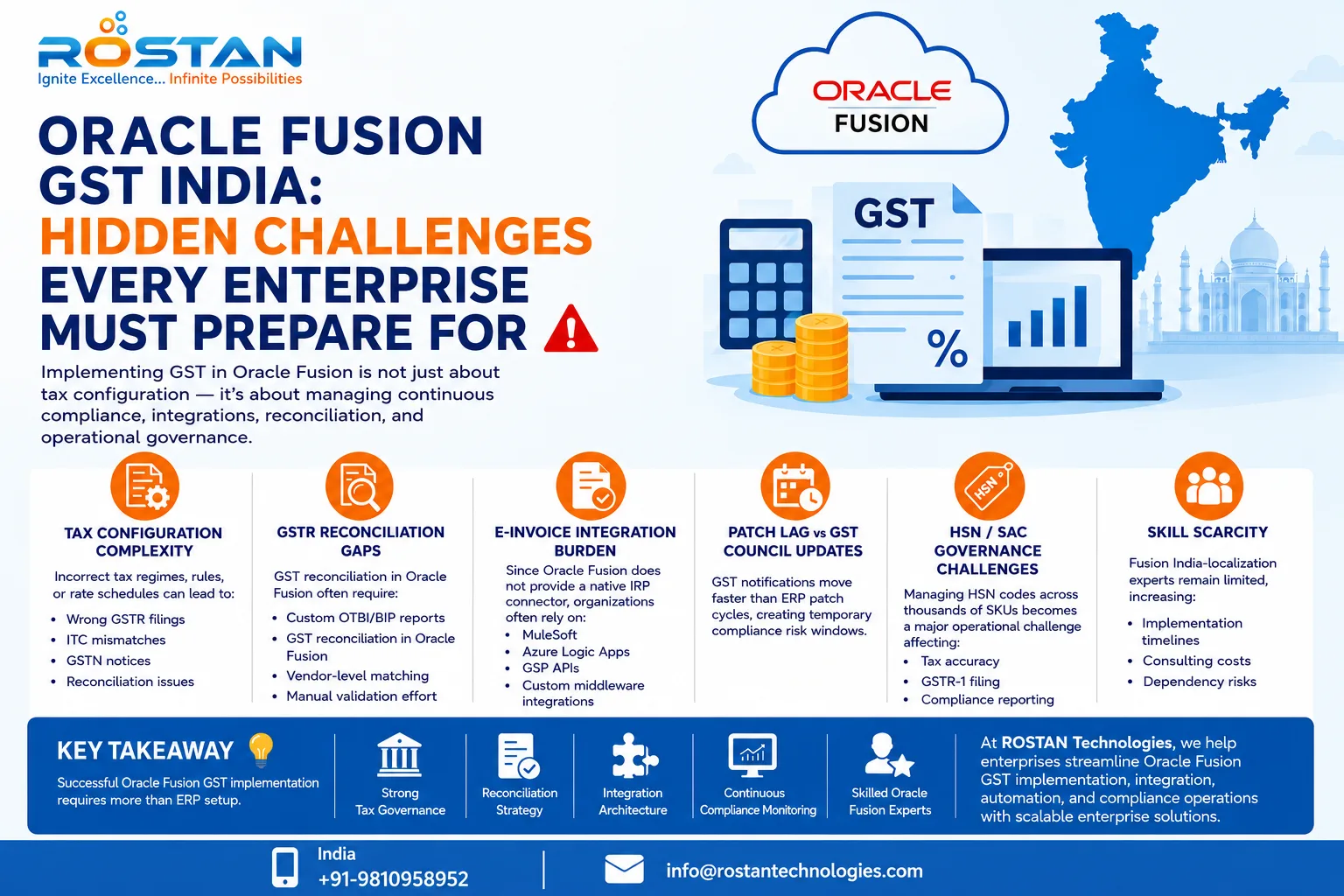
Implementing GST in Oracle Fusion Is More Than a Tax Configuration Exercise
Oracle Fusion Cloud ERP is a powerful platform — but deploying it for GST compliance in India demands far more than mapping tax codes. Enterprises face continuous compliance pressures, complex integrations, reconciliation gaps, and an acute shortage of India-localisation expertise. This article unpacks the six hidden challenges that every Oracle Fusion GST implementation team must anticipate and plan for.
⚙ Challenge 1: Tax Configuration Complexity
Oracle Fusion's Tax Engine is powerful but highly sensitive to configuration accuracy. Incorrect tax regimes, rules, or rate schedules silently propagate errors across all downstream transactions.
Misconfigurations routinely lead to:
- Wrong GSTR filings — outward supply data reported under incorrect tax heads (CGST vs IGST)
- ITC mismatches — input tax credit claimed doesn't reconcile with GSTR-2B auto-populated data
- GSTN notices — discrepancies trigger scrutiny notices from the GST Network
- Reconciliation failures — finance teams spend hundreds of manual hours correcting cascading data errors
📊 Challenge 2: GSTR Reconciliation Gaps
Oracle Fusion does not ship with ready-made GSTR-1, GSTR-3B, or GSTR-2B reconciliation reports matching India's filing formats. Enterprises are forced to build custom reconciliation pipelines that add operational overhead and introduce reconciliation lag.
Typical reconciliation workarounds include:
- Custom OTBI / Oracle BI Publisher reports mapping Fusion data to GSTR formats
- Manual vendor-level matching between Fusion purchase registers and GSTR-2B
- Azure Logic Apps or middleware for automated file generation
- Significant manual validation effort each month before filing deadlines
🔗 Challenge 3: E-Invoice Integration Burden
India mandates real-time e-invoicing (IRN generation) for businesses above ₹5 crore turnover. Oracle Fusion Cloud does not provide a native IRP connector — enterprises must build and maintain their own integration layer between Fusion and the GST IRP portal.
Common integration approaches used:
- MuleSoft — Oracle's recommended integration platform, adds licensing and maintenance cost
- Azure Logic Apps — cost-effective but requires ongoing Azure infrastructure management
- GSP APIs (Government-authorised GST Suvidha Providers) — introduces dependency on third-party SLA
- Custom middleware — highest flexibility, highest build and maintenance effort
⏰ Challenge 4: Patch Lag in GST Council Updates
India's GST Council meets frequently and notifies rate changes, new exemptions, and procedural updates — often with short effective dates. Oracle Fusion Cloud's quarterly patch cycles cannot keep pace with this regulatory velocity.
GST Council Speed
Rate notifications can take effect within 24–72 hours of council decisions.
Oracle Patch Cycle
Standard Oracle quarterly updates may lag by weeks or months for India-specific changes.
This creates temporary compliance risk windows where your ERP applies incorrect rates while awaiting an official patch — requiring manual overrides that bypass controls.
📁 Challenge 5: HSN / SAC Governance Challenges
Every product and service invoiced under GST must carry the correct 4-digit or 8-digit HSN or SAC code. For enterprises with thousands of SKUs and service lines, managing this in Oracle Fusion Item Master becomes a significant data governance challenge.
Governance failures affect:
- Tax accuracy — wrong HSN maps to wrong GST rate, causing mis-invoicing
- GSTR-1 filing — HSN Summary table requires complete and accurate HSN data for all supplies
- Compliance reporting — 8-digit HSN is mandatory for turnovers above ₹5 crore
👥 Challenge 6: India-Localisation Skill Scarcity
Oracle Fusion Cloud ERP is a global platform. Consultants with deep expertise in both Oracle Fusion's tax engine and India's GST regime are rare — creating a talent bottleneck that directly affects implementation quality, timelines, and post-go-live support.
The skill gap increases:
- Implementation timelines — projects overrun as teams learn India-specific configurations on the job
- Consulting costs — scarce expertise commands premium rates, compressing ROI
- Dependency risks — organisations become captive to a single consultant for ongoing compliance support
🔑 Key Takeaway
Successful Oracle Fusion GST implementation requires far more than ERP setup. Enterprises need:
Strong Tax
Governance
Reconciliation
Strategy
Integration
Architecture
Continuous Compliance
Monitoring
Skilled Oracle
Fusion Experts
How ROSTAN Technologies Can Help
At ROSTAN Technologies, we help enterprises streamline Oracle Fusion GST implementation, integrations, automation, and compliance operations with scalable enterprise solutions. Our India-localisation team brings hands-on experience across tax configuration, GSTR reconciliation automation, e-invoice middleware, and HSN governance programmes.
📞 India: +91-9810958952 | ✉ [email protected]