Rethinking Oracle Fusion Implementation: Functional-First, Business-Led, Built to Scale
If your finance team still has to raise a developer ticket every time it needs a structured report or a bulk data upload, you are running Oracle Fusion the old way. Modern Oracle Cloud ERP is designed to be functional-first: it turns business users into power users with minimal technical intervention, which directly lowers implementation cost, shortens deployment cycles, and improves adoption after go-live.
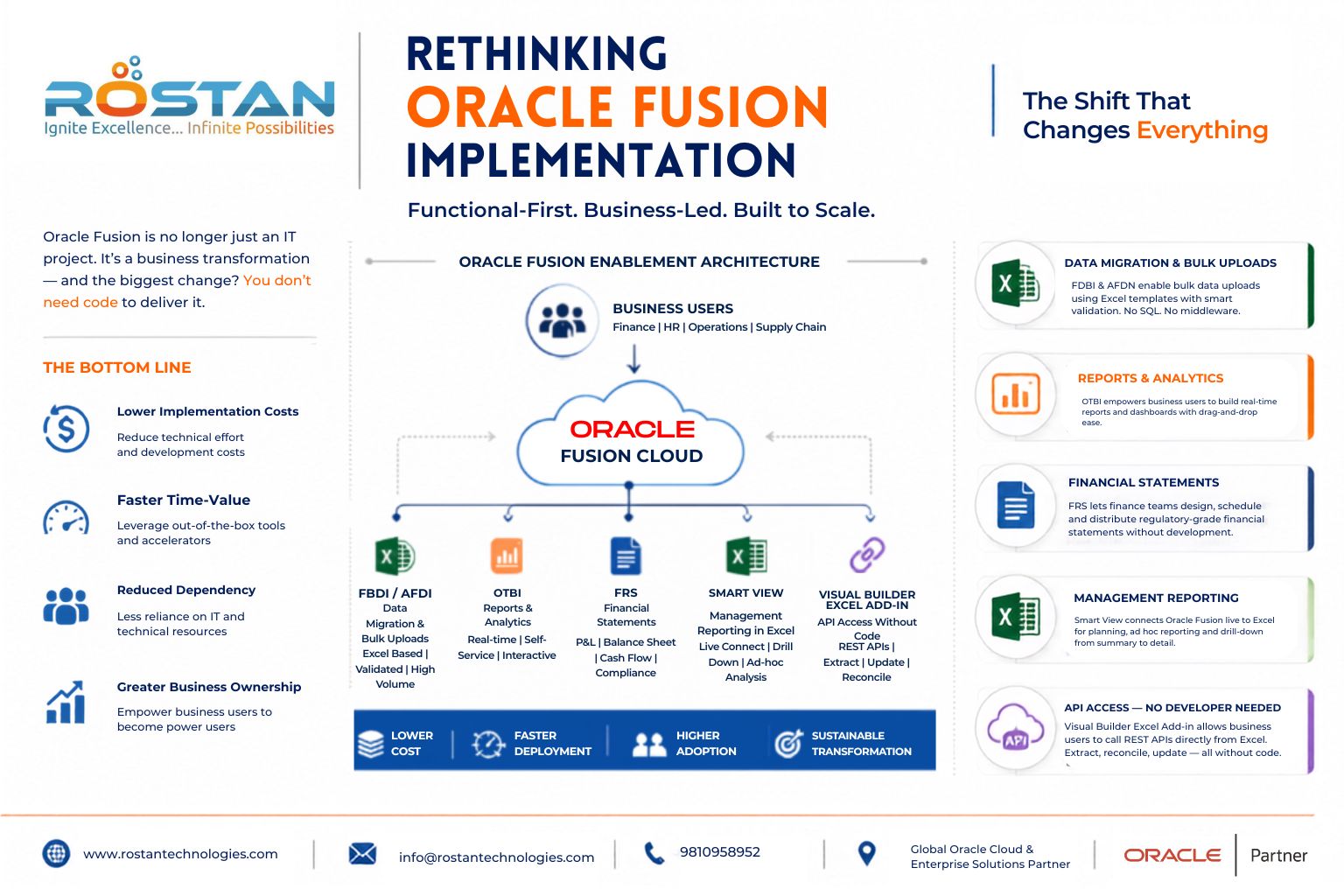
In short: A functional-first Oracle Fusion implementation maximises the platform's native tools, FBDI, ADFDI, OTBI, FRS, Smart View, and the Visual Builder Excel Add-in, so business users handle data loads, reporting, and analysis themselves instead of routing everything through custom development. The result is significantly lower implementation and support costs, faster deployment, and higher long-term independence from technical teams.
Why the Old Implementation Model Burns Budget
Many Oracle Fusion projects quietly overspend for one reason: they treat every reporting requirement, data migration, and integration as a technical task that needs a developer. Each structured report becomes a build. Each bulk upload becomes a script. Each small change becomes a change request. Over a multi-year ownership horizon, that dependency is where the real cost lives, not in the licence, but in the steady stream of technical effort required to keep the business moving.
Oracle Cloud ERP was built to break that cycle. The platform ships with a mature, functional toolkit that puts data loading, reporting, and analysis directly into the hands of the people who actually use the system. When an implementation is designed around these capabilities first, the need for heavy custom development drops sharply.
The Native Oracle Fusion Toolkit You Already Own
These tools are included with Oracle Cloud ERP. The opportunity is not to buy more, it is to use what is already there. Here is what each one lets your business users do without writing application code:
| Native Tool | What Business Users Can Do |
|---|---|
| FBDI & ADFDI | Run data migrations and bulk uploads from inside Excel using validated templates, no SQL and no middleware for high-volume loads. |
| OTBI | Build real-time, drag-and-drop transactional reports and dashboards and deliver operational insight directly to the teams who need it. |
| FRS (Financial Reporting Studio) | Design, schedule, and distribute regulatory-grade financial statements such as the P&L, balance sheet, and cash flow, entirely within finance. |
| Smart View | Connect live Oracle Cloud data to familiar spreadsheets for management reporting, ad-hoc analysis, drill-down, and live refresh. |
| Visual Builder Excel Add-in | Call Oracle Fusion REST APIs directly through Excel to extract, update, and reconcile records, powerful integration with no developer in the loop. |
The Shift That Changes Everything
When an organisation deliberately maximises these native functional capabilities, its dependency on heavy technical lift falls away. The implementation moves from a code-driven project to a configuration-and-enablement project, and the economics change with it.
- Significantly lower implementation and support costs, because fewer requirements turn into custom builds and ongoing maintenance.
- Faster deployment cycles, because configuration and native tooling move faster than bespoke development and testing.
- Higher user adoption and post-go-live independence, because business users own their reports, uploads, and analysis instead of waiting in a ticket queue.
How to Move to a Functional-First Footprint
Shifting to a functional-first model is a deliberate design choice made early, not a clean-up exercise after go-live. The pattern we apply with clients is straightforward:
- Map requirements to native tools first. Before approving any custom development, ask whether FBDI, ADFDI, OTBI, FRS, Smart View, or the Visual Builder Add-in can already meet the need.
- Reserve custom code for true differentiators. Keep development for the handful of processes that are genuinely unique to your business, not for standard reporting and loads.
- Enable the business, not just the IT team. Train finance, HR, operations, and supply-chain users on the tools they will own so adoption is built in from day one.
- Govern the toolkit. Put light guardrails around report libraries, data templates, and API access so business-led agility stays secure and consistent.
Conclusion: ERP Delivery Driven by Business-Led Agility
The future of ERP delivery is not hidden behind lines of code. It is driven by business-led agility, by giving capable users the native tools to manage their own data, reporting, and analysis. Oracle Fusion already provides that toolkit. The organisations that win are the ones that design their implementation around it, optimising the Fusion footprint, reducing technical overhead, and freeing their IT teams to focus on genuine innovation rather than routine requests.
Want to optimise your Oracle Fusion footprint and reduce technical overhead?
ROSTAN Technologies is an Oracle Gold Partner with 11+ years of experience and 800+ enterprise implementations across 20+ countries. We help organisations adopt a functional-first Oracle Cloud ERP model that lowers cost, speeds up deployment, and gives business users lasting independence. Download the detailed guide below or talk to our Oracle Fusion team.
Book a Free Consultation