Trusted Digital Transformation Partner
Ind AS 116 Lease Accounting in Oracle Fusion Cloud: Implementation Guide
- By Rajkumar Awasthi, Vice President — Oracle Delivery
- Published Jul 27, 2026
How Oracle Fusion Cloud handles Ind AS 116 lease accounting — right-of-use assets, lease liabilities, remeasurement & disclosures, and what EBS lacks natively.
In short: Ind AS 116 requires lessees to bring almost every lease onto the balance sheet as a right-of-use (ROU) asset and a corresponding lease liability — no more off-balance-sheet operating leases for branch premises, warehouses, vehicles or equipment. Oracle Fusion Cloud has a native lease-accounting capability built for exactly this (originally built to the near-identical US standard ASC 842 and IFRS 16, which Ind AS 116 mirrors closely), and getting it configured correctly the first time avoids a painful manual remeasurement exercise every time a lease term changes.
What Ind AS 116 actually changed
Before Ind AS 116, operating leases were an expense line — rent paid, rent expensed, nothing on the balance sheet. Ind AS 116 (India's adoption of the international IFRS 16 standard, effective for accounting periods beginning on or after 1 April 2019) removed that distinction for lessees: with narrow exceptions for short-term leases (12 months or less) and low-value assets, every lease creates a right-of-use asset and a lease liability on initial recognition, measured at the present value of future lease payments. The expense profile also changes — instead of a straight-line rent expense, the income statement shows depreciation on the ROU asset plus interest expense on the lease liability, which is front-loaded compared to the old straight-line rent expense.
Why this is harder than it looks in a spreadsheet
A single lease is a manageable spreadsheet calculation. An enterprise with hundreds of branch, warehouse, vehicle and equipment leases — the normal state for a BFSI branch network or a manufacturer with multiple plants — is not. Each lease needs its own discount-rate determination, payment schedule, and remeasurement trigger tracking: a rent escalation, a lease modification, a change in the assessment of a renewal option, or an index-linked payment change all require the ROU asset and liability to be recalculated, not just noted. Doing this in spreadsheets at scale is where errors and audit findings come from — a formula copied incorrectly across hundreds of leases is very hard to catch.
How Oracle Fusion Cloud's lease-accounting capability handles it
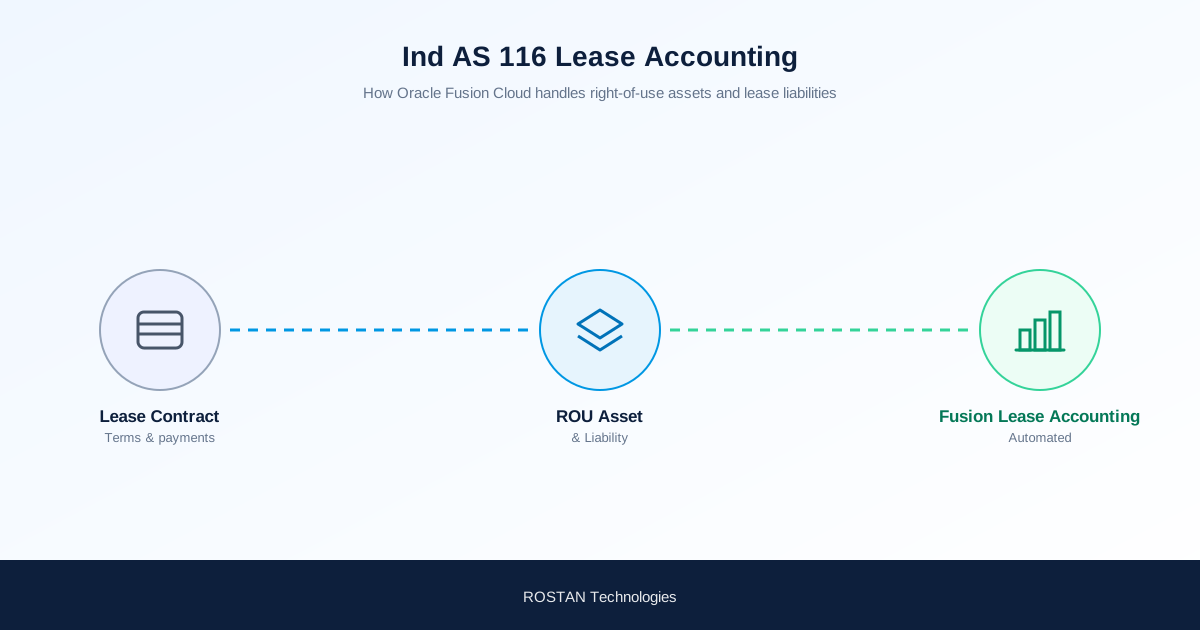
Oracle Fusion Cloud includes native lease-accounting functionality that calculates the ROU asset and lease liability from the lease terms entered — payment schedule, discount rate, lease term and any renewal or termination options — and automatically generates the periodic depreciation and interest journal entries. Remeasurement events (a modification, an index change, a reassessed renewal likelihood) are handled as calculated adjustments rather than a manual recalculation, and the required Ind AS 116 disclosures (maturity analysis of lease liabilities, ROU asset roll-forward, variable lease payments not included in the liability) are produced from the same underlying data rather than assembled separately for the auditor.
What this requires to set up correctly
The configuration work that determines whether this runs cleanly is mostly in the data, not the software: a complete and accurate lease register (every lease, its terms, payment schedule and any embedded options) has to exist before go-live, the discount-rate methodology (incremental borrowing rate, typically) has to be defined and applied consistently, and the classification judgment calls — is a service contract actually an embedded lease under Ind AS 116's definition, is a renewal option reasonably certain to be exercised — have to be made deliberately rather than defaulted. Getting the initial lease register wrong is the single most common cause of restatement in Ind AS 116 adoption projects, well documented across early adopters of the standard.
Oracle EBS versus Fusion Cloud for lease accounting
This capability is specifically a Fusion Cloud feature. Oracle E-Business Suite has no equivalent native Ind AS 116 lease-accounting engine — EBS-based enterprises handling this compliance requirement typically use a third-party lease-accounting tool integrated with EBS, a spreadsheet-based calculation with a controlled journal-upload process, or run lease accounting on Fusion Cloud while the operational ERP remains on EBS. Which approach makes sense depends on lease volume and existing system landscape, and is worth assessing honestly before committing to a build.
Running EBS instead of Fusion? See how ROSTAN approaches Oracle EBS support and Fusion migration to weigh the options for lease-accounting compliance on your current platform.
Oracle Fusion Cloud & EBS
We implement Oracle Fusion Cloud and support Oracle E-Business Suite. If someone is telling you EBS is end-of-life, read this first — Oracle has committed Premier Support through at least 2037.
See our Oracle ERP servicesFrequently Asked Questions

Get a free Oracle Health Check
Our Oracle Gold Partner experts review your EBS, Fusion Cloud or APEX environment and send a written report on performance gaps, cost savings and upgrade risk.
Have questions about Oracle, AWS or Cloud?
Talk to our certified experts — free consultation, no commitment.
Recent Post




Talk to an Oracle ERP consultant
If this article raised a question about your own EBS or Fusion estate, tell us what you are running. You will get a considered answer from a consultant, not a sales sequence.