Trusted Digital Transformation Partner
Oracle Fusion Analytics Warehouse (FAW): What It Actually Is
- By Virender Kumar, Head of Cloud & Database
- Published Jul 27, 2026
What Oracle Fusion Analytics Warehouse (FAW) actually is, how it differs from a general Oracle Analytics Cloud build, and who it is genuinely a good fit for.
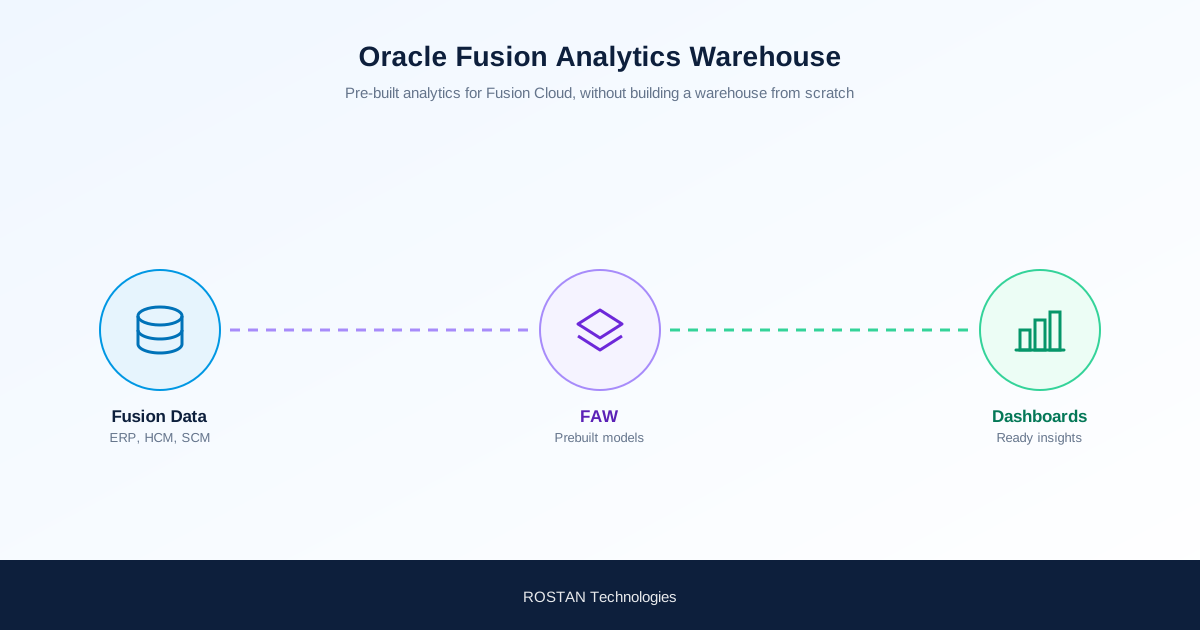
In short: Oracle Fusion Analytics Warehouse (FAW) is not a general-purpose BI platform — it is a pre-built analytics product specifically for Oracle Fusion Cloud Applications (ERP, HCM, SCM), shipping with ready-made data models, KPIs and dashboards for those applications rather than a blank canvas you build reporting on top of. Understanding that distinction is what stops it being mis-evaluated against a general BI tool like OAC or Power BI, which it is not competing with directly.
What FAW actually is
Fusion Analytics Warehouse combines a pre-built data warehouse (extracting and modelling data out of Fusion Cloud Applications automatically), a curated semantic layer designed around Fusion's own data structures, and Oracle Analytics Cloud as the presentation layer on top — delivered as a packaged product rather than something built from scratch. The pitch is specifically for organisations already running Oracle Fusion Cloud ERP, HCM or SCM who want cross-pillar analytics (finance and supply chain data together, for example) without building that data warehouse and semantic model themselves.
Where it fits versus a general BI build on OAC
A general Oracle Analytics Cloud implementation is a blank platform — you connect your own data sources, build your own semantic model, design your own dashboards. FAW is the opposite: pre-built content specifically for Fusion Applications data, which is faster to stand up if your reporting need genuinely maps to what Fusion ships and slower to bend if your requirements diverge from the pre-built model. The honest evaluation question is not "which is better" but "does our reporting need match what FAW ships out of the box, or do we need enough customisation that we are effectively building our own analytics platform anyway" — in which case a general OAC build, using FAW's underlying data extracts where useful, may be the better starting point.
What it does not do
FAW is built around Fusion Cloud Applications data. It is not the tool for reporting that spans Oracle EBS, third-party systems, and Fusion together in one unified model — that kind of cross-platform reporting is a general OAC (or another BI platform) exercise, potentially drawing on FAW's Fusion-side extracts as one input among several. Organisations running a mixed EBS-plus-Fusion estate, which is common during a phased Fusion migration, need to plan analytics architecture with that mixed-source reality in mind rather than assuming FAW alone covers it.
Who it is actually a good fit for
FAW makes the most sense for organisations that are substantially on Fusion Cloud Applications already (not mid-migration with most data still on EBS), want faster time-to-value on standard Fusion reporting (finance close metrics, supply chain KPIs, workforce analytics) than a from-scratch OAC build would deliver, and whose reporting requirements are close enough to Fusion's standard data model that the pre-built content covers most of the need, with targeted extensions rather than a wholesale rebuild.
The practical starting question
Before committing to FAW, OAC, or a mixed approach, the useful exercise is mapping actual reporting requirements against what FAW ships pre-built — which KPIs and dashboards genuinely match, and which would need meaningful customisation. That mapping, not a generic recommendation, is what determines whether FAW's packaged approach saves real implementation time or just becomes a starting template that gets substantially rebuilt anyway.
Oracle EBS & Database Services
Most Oracle performance problems do not start inside Oracle. We tune the whole ecosystem — SGA and PGA sizing, kernel parameters, storage and SQL.
See our Oracle EBS practiceFrequently Asked Questions

Get a free Oracle Health Check
Our Oracle Gold Partner experts review your EBS, Fusion Cloud or APEX environment and send a written report on performance gaps, cost savings and upgrade risk.
Have questions about Oracle, AWS or Cloud?
Talk to our certified experts — free consultation, no commitment.
Recent Post



Talk to an Oracle DBA
Performance, patching, cloning, upgrades or recovery — describe the symptom and we will tell you what usually causes it and what it takes to fix properly.