Trusted Digital Transformation Partner
Is Oracle OBIEE Still Supported? What the Extended Support End Means
- By Virender Kumar, Head of Cloud & Database
- Published Jul 27, 2026
OBIEE 12c Extended Support ended August 2025 with no 14c release. What Sustaining Support means and how to scope the move to Oracle Analytics.
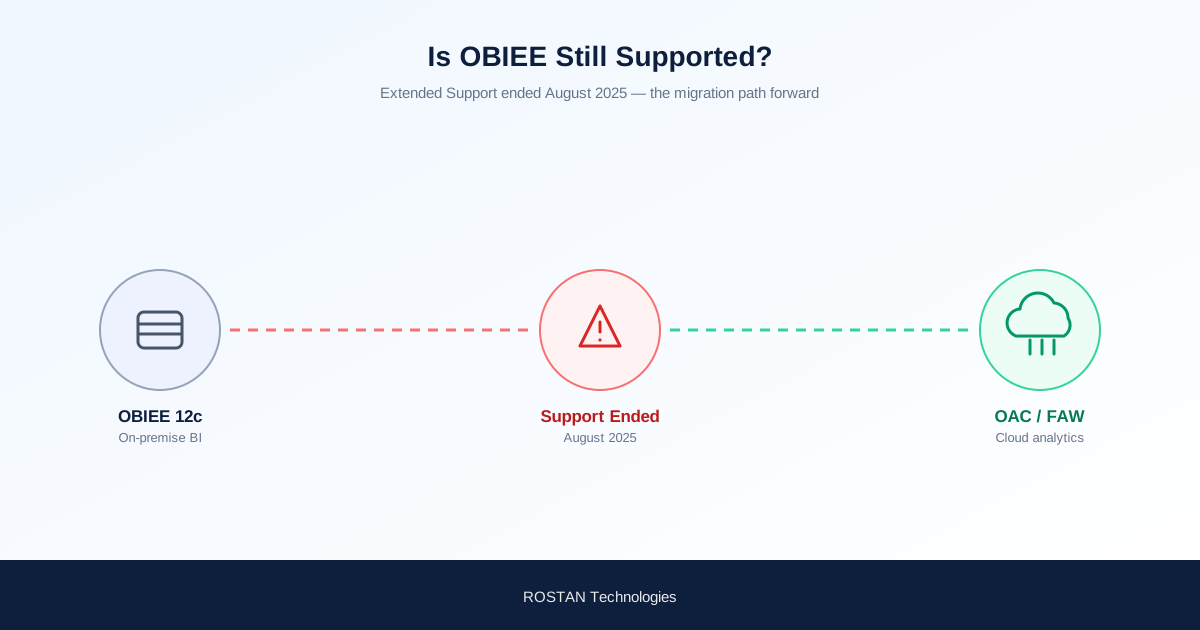
In short: Oracle BI Enterprise Edition (OBIEE) 12c's Extended Support window closed in August 2025 — it is not "winding down," it is already past the end of its support lifecycle. OBIEE and Oracle BI have no 14c release; the forward path is Oracle Analytics Server (the on-premises successor) or Oracle Analytics Cloud (OAC). If your enterprise reporting still runs on OBIEE 12c, this is the Oracle Fusion Middleware component to schedule first, ahead of anything with a later deadline.
What "extended support has ended" actually means
Oracle's Lifetime Support Policy runs software through three phases: Premier Support, Extended Support (paid, with a narrower scope — typically no new certifications, limited patching), and Sustaining Support (effectively best-effort, no new fixes). Once Extended Support closes, a product enters Sustaining Support — Oracle will generally still take a support call, but there are no more bug fixes, no new certifications against newer database or OS versions, and no security patches for newly discovered vulnerabilities. For a reporting platform that many parts of the business depend on daily, running past that point is a live operational risk, not a compliance technicality.
Why this is more urgent than the broader Fusion Middleware 12c timeline
Oracle Fusion Middleware 12c (12.2.1.4) as a broader release line has its own Premier and Extended Support dates running further out. OBIEE specifically does not follow that same longer runway — its Extended Support already closed in August 2025, independent of where the rest of the 12c stack sits. That distinction matters in planning: an IT team tracking "Fusion Middleware 12c end of support" as a single date can miss that OBIEE itself was already the most time-sensitive component inside that stack.
There is no OBIEE 14c — this is a replace decision, not an upgrade
Some Fusion Middleware 12c products have a defined 14c upgrade path. OBIEE and Oracle BI do not. That changes the nature of the project: instead of a version upgrade that largely preserves the existing architecture, moving off OBIEE 12c means choosing between Oracle Analytics Server (broadly the closest on-premises equivalent, for organisations that need to keep BI infrastructure on-premises) or Oracle Analytics Cloud (Oracle's cloud-native analytics platform, and the direction Oracle has been steering customers toward for several years). Both are genuinely different products from OBIEE, not a drop-in replacement — dashboards, RPD-based semantic models and reports typically require conversion work, not a simple reinstall.
What to check before scoping a move
The scoping work that actually determines project size: an inventory of the RPD (the semantic model — subject areas, joins, calculations) and how much of it is still genuinely used versus historical cruft nobody has cleaned up; how many dashboards and analyses exist and how many are actively viewed rather than abandoned; whether reports depend on OBIEE-specific customisations (custom Java plugins, BI Publisher templates with heavy formatting logic) that need explicit conversion; and whether the target is OAC (cloud, ongoing subscription) or Oracle Analytics Server (on-premises, closer to OBIEE's original deployment model) — a decision that depends more on data residency and existing infrastructure commitments than on the reporting content itself.
The honest starting point
Given that Extended Support has already ended, the question for most OBIEE 12c estates is no longer "when should we plan this" but "how much of our current reporting is worth carrying forward, and to which target platform." An RPD and dashboard audit — a few weeks of work for a mid-sized estate — gives a real answer instead of assuming everything needs to move as-is.
Planning the move? See ROSTAN's OBIEE to Oracle Analytics Cloud migration guide for what actually converts and what has to be rebuilt.
Oracle EBS & Database Services
Most Oracle performance problems do not start inside Oracle. We tune the whole ecosystem — SGA and PGA sizing, kernel parameters, storage and SQL.
See our Oracle EBS practiceFrequently Asked Questions

Get a free Oracle Health Check
Our Oracle Gold Partner experts review your EBS, Fusion Cloud or APEX environment and send a written report on performance gaps, cost savings and upgrade risk.
Have questions about Oracle, AWS or Cloud?
Talk to our certified experts — free consultation, no commitment.
Recent Post



Talk to an Oracle DBA
Performance, patching, cloning, upgrades or recovery — describe the symptom and we will tell you what usually causes it and what it takes to fix properly.