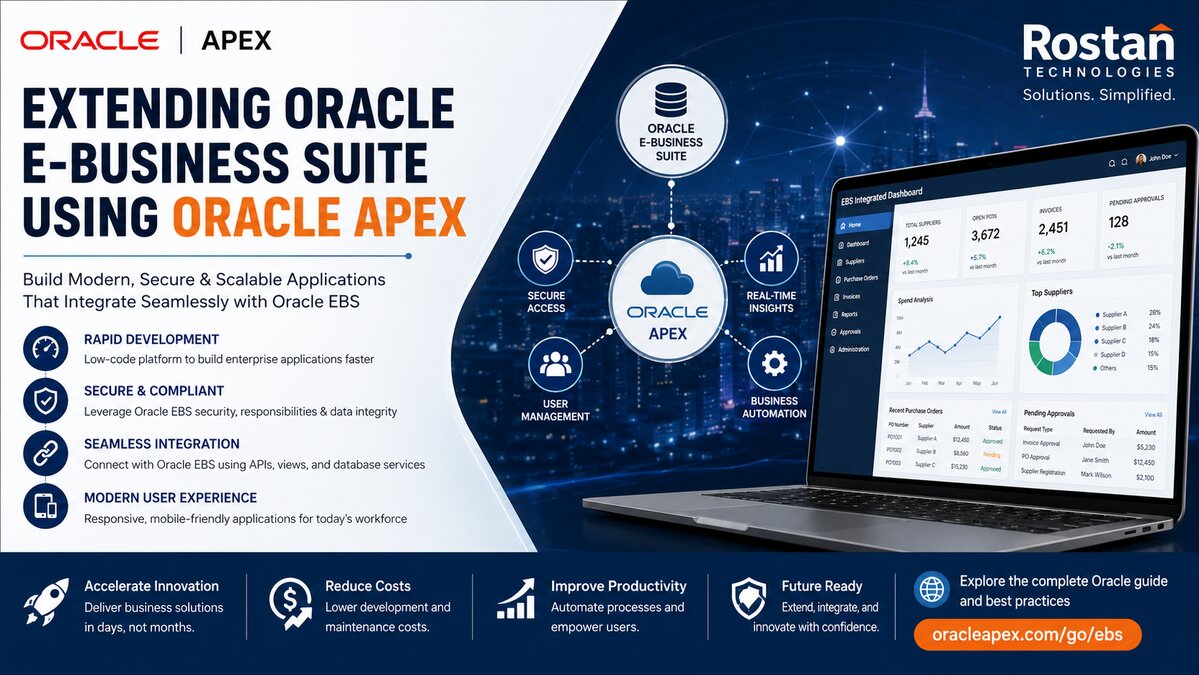
Extending Oracle E-Business Suite Using Oracle APEX: The Complete Enterprise Guide
Oracle E-Business Suite has been one of the most trusted ERP platforms for organizations worldwide, powering Finance, Procurement, Supply Chain, Manufacturing, HR, Projects and CRM. But as businesses evolve, they need functionality beyond EBS's standard capabilities — and Oracle's own recommendation is not to customize the core application to get it.
Organizations need supplier portals, customer self-service applications, executive dashboards, workflow automation, AI-powered assistants, mobile applications, approval systems and industry-specific solutions. Traditionally, many businesses met these needs by customizing Oracle EBS directly. That solved the immediate requirement, but it often led to upgrade challenges, higher maintenance costs and unsupported customizations.
Oracle recommends a different approach: extend Oracle E-Business Suite using Oracle APEX instead of customizing the core ERP application. Oracle APEX lets organizations build secure, scalable, enterprise-grade applications rapidly while keeping Oracle EBS stable, upgradeable and fully supported.
Understanding Oracle E-Business Suite
Oracle EBS is a comprehensive ERP solution that integrates every major business function into a single platform, rather than running separate systems for finance, procurement, inventory and HR. Key modules include:
- Financial Management
- Procurement
- Order Management
- Inventory Management
- Manufacturing
- Supply Chain Planning
- Human Capital Management (HRMS)
- Projects
- Asset Management
- Customer Relationship Management (CRM)
Despite this breadth, every organization has unique processes that need functionality beyond standard ERP features.
Why organizations need to extend Oracle EBS
No two businesses operate exactly the same way. Organizations frequently need custom solutions such as:
- Supplier self-service portals
- Customer portals
- Employee self-service applications
- Approval workflow systems
- Executive dashboards
- Mobile applications
- Help desk systems
- Visitor management
- Asset tracking solutions
- AI-powered business assistants
- Document management systems
- Compliance applications
- Vendor onboarding portals
Oracle EBS manages core ERP processes exceptionally well, but these additional applications usually need modern user interfaces, responsive web design and rapid development — not more of EBS's core.
The problem with traditional customization
For years, organizations customized Oracle EBS by modifying standard components — Oracle Forms, standard packages, database tables, Oracle Reports and APPS schema objects. These customizations met immediate requirements, but introduced long-term problems:
- Difficult Oracle upgrades
- Patch conflicts
- Unsupported modifications
- Increased maintenance costs
- Security risks
- Performance degradation
- Longer testing cycles
Every Oracle patch or version upgrade forced organizations to retest, and sometimes rebuild, customized components — significantly increasing implementation cost over time.
Oracle's recommended strategy: do not customize Oracle E-Business Suite whenever an extension can achieve the same business objective. Build separate applications using Oracle APEX that securely integrate with Oracle EBS.
This strategy lets organizations keep Oracle EBS untouched, build modern applications rapidly, simplify upgrades, reduce maintenance costs, improve user experience, and stay within Oracle's supported architecture.
What is Oracle APEX?
Oracle Application Express (Oracle APEX) is Oracle's low-code development platform that runs entirely within the Oracle Database. Developers can build enterprise applications quickly without extensive Java or .NET development. Common Oracle APEX applications include dashboards, data entry applications, workflow systems, approval applications, vendor portals, customer portals, mobile applications, reporting systems, REST API integrations and AI-powered applications.
Because Oracle APEX is built on the Oracle Database, it integrates naturally with Oracle EBS while benefiting from the database's security, scalability and performance.
Oracle's extension philosophy, in one line: keep Oracle EBS standard. Build innovation using Oracle APEX.
Oracle's recommended architecture
Oracle recommends a layered architecture where Oracle APEX communicates securely with Oracle EBS, keeping custom applications completely separate from the EBS core:
This ensures secure communication while maintaining complete separation between custom applications and the Oracle EBS core.
Never develop inside the APPS schema
One of Oracle's strongest recommendations: do not build Oracle APEX applications directly inside the APPS schema. Instead, create a dedicated custom schema, such as XX_APEX or XX_CUSTOM.
The APPS schema has unrestricted access to nearly every Oracle EBS object. If Oracle APEX connects directly through APPS, an accidental update or deletion could impact production ERP data. A dedicated custom schema gives you better security, controlled access, easier maintenance, cleaner architecture, and keeps you within Oracle support compliance.
Access data through database views
Oracle recommends exposing EBS data through custom database views rather than letting Oracle APEX query application tables directly — for example:
XX_EMPLOYEE_DETAILS_VXX_SUPPLIER_DETAILS_VXX_PURCHASE_ORDER_V
This gives you simplified SQL, better security, controlled data exposure, easier maintenance and improved performance.
Never update Oracle EBS tables directly
Another critical recommendation: never perform direct INSERT, UPDATE or DELETE operations on Oracle EBS tables. Instead of statements like UPDATE FND_USER or UPDATE PO_HEADERS_ALL, use Oracle's supported public APIs — for example FND_USER_PKG, PO APIs, HZ APIs, AP Supplier APIs and Inventory APIs. Going through the API layer preserves business validations, audit processing, workflow execution, data integrity and future compatibility.
Authentication and authorization
Oracle recommends integrating Oracle APEX authentication with Oracle EBS, so users log in once and access APEX applications without entering credentials again — a single sign-on experience with improved security and centralized authentication.
Oracle also recommends leveraging Oracle EBS Responsibilities for authorization. If a user has access to Procurement within Oracle EBS, Oracle APEX should automatically respect those permissions, giving you consistent security, centralized authorization and simplified administration.
Rather than making Oracle APEX feel like an external application, Oracle recommends registering it inside Oracle EBS menus, so users can launch APEX applications directly from the EBS navigation for a seamless experience.
Security best practices
- Use a dedicated custom schema
- Never develop inside APPS
- Use Oracle public APIs
- Expose data through views
- Implement role-based security
- Enable session protection
- Validate all user input
- Apply least-privilege access
- Protect sensitive business data
Real-world use cases
Oracle APEX can extend Oracle EBS with applications such as:
- Supplier portal
- Employee self-service
- Customer portal
- Vendor registration
- Executive dashboards
- Approval workflows
- Asset management
- Field service applications
- AI chatbots
- Mobile inspection apps
- Compliance tracking
- Document management
- Procurement analytics
- Inventory dashboards
Benefits of extending Oracle EBS with Oracle APEX
Faster development
Applications built in weeks instead of months.
Modern user experience
Responsive apps for desktop, tablet and mobile.
Upgrade-friendly
EBS upgrades get easier because the core stays unchanged.
Lower maintenance costs
Custom applications stay isolated from Oracle EBS.
Enterprise security
Built on Oracle Database security and EBS authentication.
AI ready
REST APIs and AI integrations for intelligent applications.
Organizations adopting this architecture reduce total cost of ownership — maximizing their existing Oracle investment while rapidly delivering new business capabilities.
The summary
Oracle's recommended approach represents a shift from ERP customization to ERP extension. Instead of modifying Oracle E-Business Suite, organizations should build independent Oracle APEX applications that securely integrate with Oracle EBS using supported APIs, database views, authentication and authorization mechanisms.
This strategy helps businesses modernize their ERP landscape while preserving upgradeability, security, performance and Oracle support — whether you're building dashboards, supplier portals, workflow systems, AI-powered assistants or mobile applications.
This article is a simplified explanation of Oracle's recommended approach for extending Oracle E-Business Suite using Oracle APEX. For the complete official implementation guide — architecture, installation, authentication, security, integration and deployment — see Oracle's own technical guide: oracleapex.com/go/ebs. Related reading on ROSTAN: Oracle APEX Development & Migration Services and Oracle Forms to APEX Migration.
Extend Oracle EBS without touching the core
ROSTAN Technologies builds Oracle APEX applications that integrate securely with Oracle EBS — supplier portals, dashboards, approval workflows and mobile applications — using Oracle's own recommended architecture, custom schemas, APIs and authentication. Get an assessment of what you can extend instead of customize.
Talk to Our Oracle APEX Team