AI-Powered Oracle APEX: Automating Enterprise Workflows in 2026
Many organisations still run business-critical processes on spreadsheets, email threads, and manual approvals. The cost is rarely a single line item; it shows up as lost hours, delayed decisions, re-keyed data, and blind spots in operations. Pairing generative AI with Oracle APEX gives teams a practical way to automate those processes and build secure, enterprise-grade applications on the Oracle Database they already license, in weeks rather than months.
The Real Cost of Manual, Disconnected Processes
When finance, procurement, HR, and operations each work in their own tools, the gaps between those tools become the bottleneck. An invoice waits in an inbox. An approval sits with someone on leave. A figure gets copied from one sheet into another, with a typo. None of these are dramatic on their own, but together they slow the whole organisation down and make it hard to trust the numbers.
The usual response, a large custom-development project or a full ERP re-implementation, is expensive and slow. Oracle APEX offers a different path: a low-code platform that sits directly on the Oracle Database, so you build on infrastructure you already own and avoid a separate application stack to license and maintain.
What Changes When You Add AI to Oracle APEX
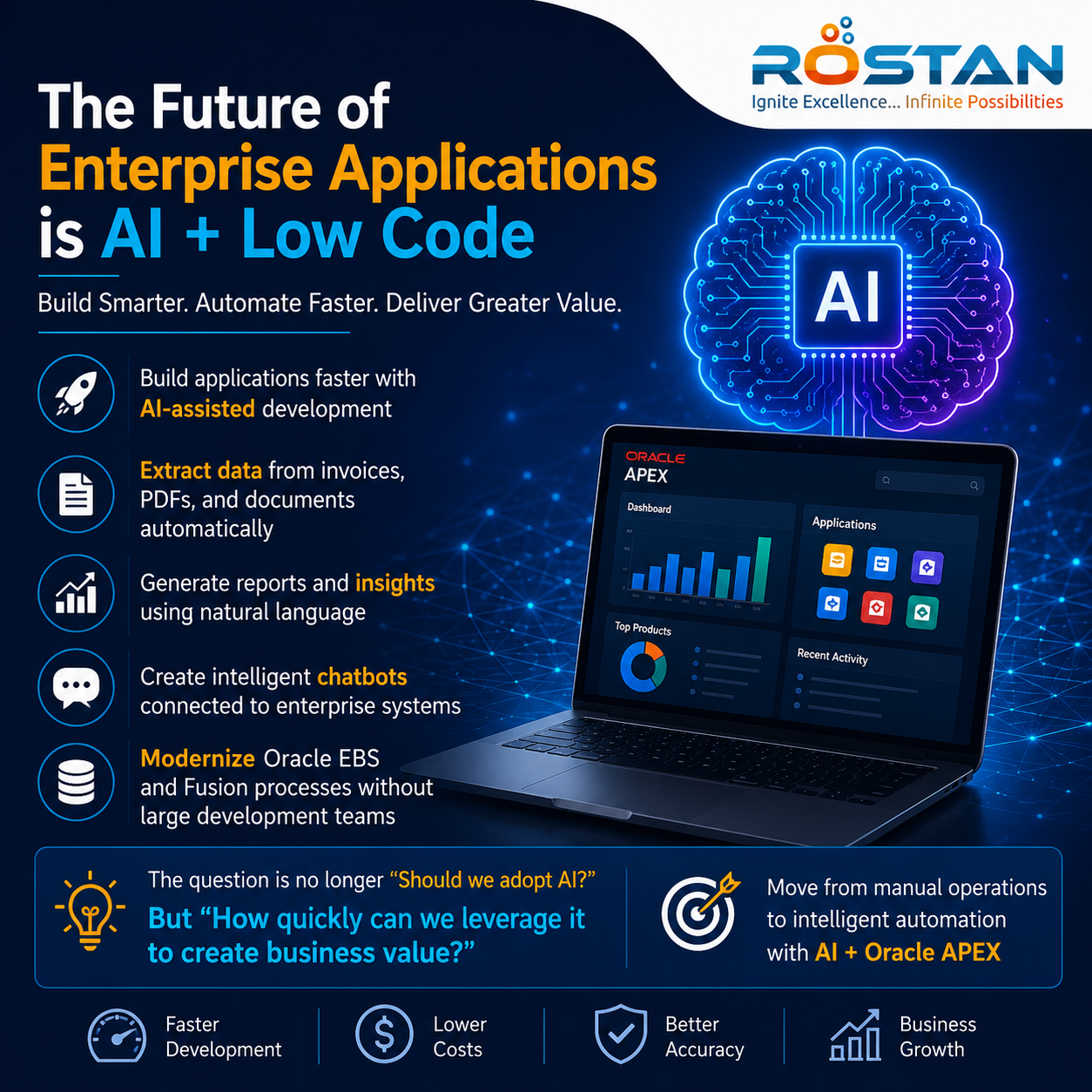
Oracle APEX already accelerates application delivery. Adding AI extends what those applications can do, moving them from recording data to actively working with it. In practice, AI-enabled APEX applications can:
- Read invoices and documents automatically — extract supplier, amount, tax, and line items from PDFs and scanned files instead of typing them in.
- Pull data out of emails and attachments — turn unstructured messages into structured records ready for processing.
- Answer questions in plain language — let staff ask for a figure or a status and get an answer without writing a report or a query.
- Run intelligent assistants — give employees and customers chatbots that understand context and act on it.
- Flag bottlenecks before they happen — predict where an approval or a process is likely to stall and alert the right person early.
- Send proactive notifications — surface exceptions and deadlines instead of waiting for someone to go looking.
The point is not AI for its own sake. It is removing the repetitive, low-value steps so people spend their time on judgement and exceptions, while the routine flow handles itself.
Modernising Oracle EBS and Fusion Without a Rebuild
One of the strongest cases for AI plus Oracle APEX is extending what you already have. Rather than replacing Oracle E-Business Suite or Fusion, you can build focused applications around them that close specific gaps, an approval workflow, a self-service portal, an exception tracker, while keeping the core ERP intact.
Because APEX integrates cleanly with Oracle EBS, Oracle Fusion, SAP, and third-party APIs, these applications fit into your existing landscape instead of forcing a rip-and-replace. You protect the investment already made in your ERP and add capability where the business actually feels the pain.
Practical Use Cases We See Most Often
AI-enabled APEX is not theoretical. These are the applications organisations build first, because the return is clear and the scope is contained:
Capture, validate, and route supplier invoices with minimal manual entry.
Route requests through rules-based approvals with full audit history.
Surface mismatches and blocked POs before they delay delivery.
Let staff raise, track, and resolve requests without email chains.
Collect, verify, and approve vendor details in one guided flow.
Store, search, and track documents with AI-assisted extraction.
The Business Outcomes That Matter
When routine work is automated and data is connected, the benefits compound across the organisation:
- Faster decisions, because the information is current and in one place.
- Lower operating costs, because fewer hours go into manual handling and rework.
- Higher productivity, because staff focus on exceptions, not data entry.
- Better customer and employee experience, through self-service and quicker responses.
- Complete process visibility, with dashboards that show status in real time.
- Stronger compliance and audit readiness, thanks to built-in audit trails and controls.
AI Is a Competitive Advantage You Can Use Today
AI is no longer a future roadmap item. Organisations that combine it with Oracle APEX can build secure, scalable, enterprise-grade applications quickly, while getting more value from the ERP investments they have already made. The combination lets you start small with a single high-impact process and expand as the results prove themselves.
Ready to modernise your Oracle EBS, Fusion, SAP, or legacy systems?
ROSTAN Technologies is an Oracle Gold Partner. We help enterprises across India and the Middle East build AI-enabled Oracle APEX applications that deliver measurable value. Let us scope a focused first project with you.
Book a Free Consultation