Trusted Digital Transformation Partner

E-Invoicing Integration with Oracle Fusion Cloud: Complete Guide for Indian Businesses (2026)
- Article By : Rostan Team
- May 08, 2026
India's GST e-invoicing mandate has expanded to cover businesses with an annual turnover above ₹5 crore — and as Phase 4 enforcement tightens in 2026, integrating your Oracle Fusion Cloud ERP with the Invoice Registration Portal (IRP) is no longer optional. This guide covers everything you need to know, from architecture to go-live.
What Is GST E-Invoicing?
E-invoicing under GST does not mean creating invoices in a government portal. Instead, your ERP system generates the invoice in the standard JSON schema prescribed by GSTN, sends it to the IRP, and receives back:
- A unique Invoice Reference Number (IRN)
- A digitally signed JSON
- A QR code that must be printed on every B2B invoice
Without a valid IRN, your invoice is not legally valid under GST law — buyers cannot claim Input Tax Credit (ITC) against it.
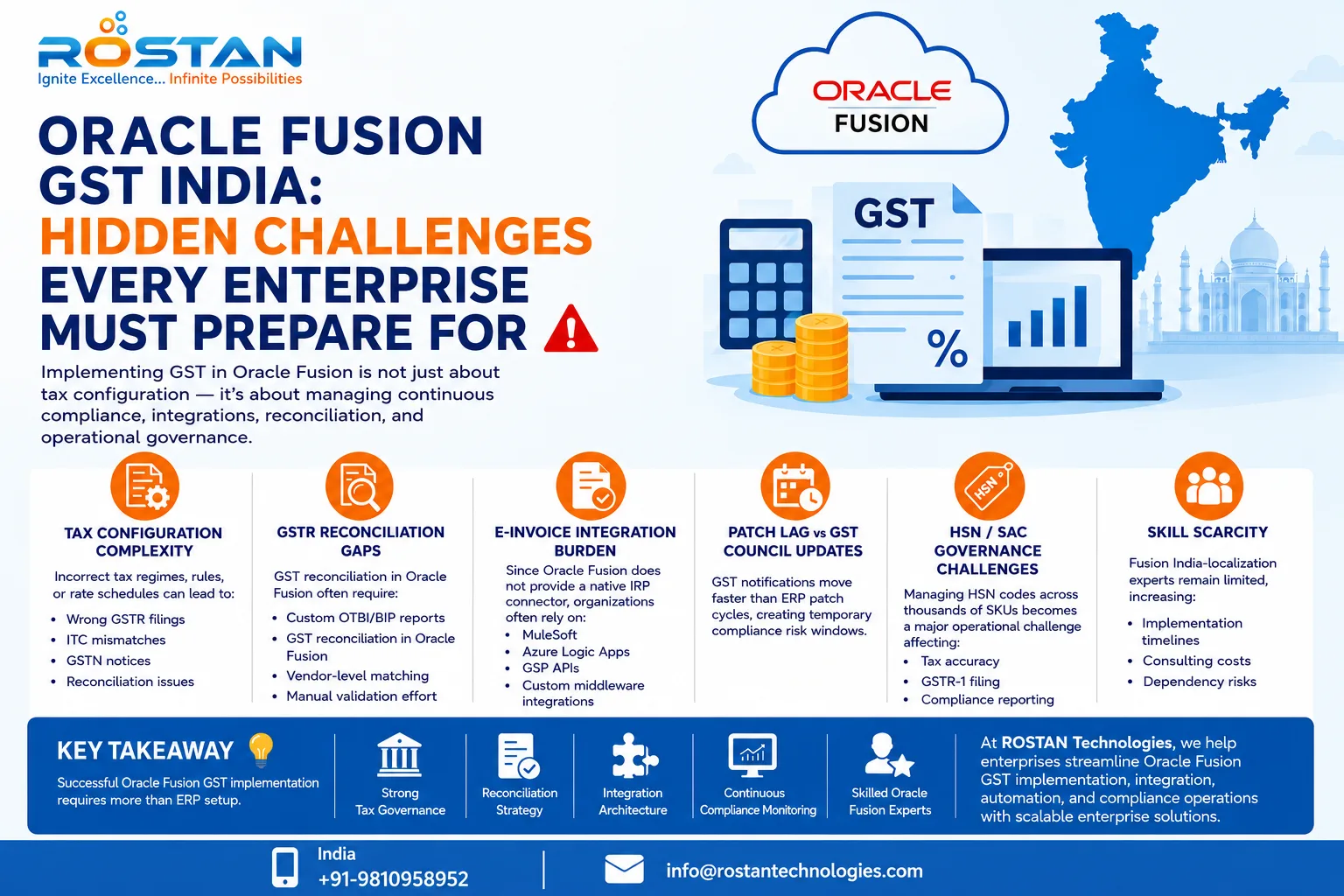
How Oracle Fusion Cloud Handles E-Invoicing
Oracle Fusion Cloud Financials (ERP Cloud) supports e-invoicing for India through the Financials for India localisation module. There are two integration architectures commonly used:
Architecture 1: Direct IRP API Integration
Oracle ERP connects directly to the IRP (or an accredited GSP — GST Suvidha Provider) via REST APIs. This is the recommended approach for businesses generating more than 500 invoices per day.
- Enable the India Localisation feature in Oracle Fusion setup
- Configure the GSP credentials (API Key, Client ID, Secret) in Oracle Financials setup
- Map Oracle transaction types to GSTN document types (INV, CRN, DBN)
- Set up the IRP endpoint in the Integration Cloud / REST catalogue
- Configure auto-IRN generation on invoice completion
- Map IRN and QR code fields back to the Oracle invoice layout
Architecture 2: Middleware / GSP Layer
Oracle ERP pushes invoice data to a middleware (Oracle Integration Cloud, MuleSoft, or a third-party GSP) which handles IRP communication. This is preferred when Oracle is one of several ERP systems in a group company.
Key Technical Requirements
| Requirement | Detail |
|---|---|
| GSTN Schema Version | e-Invoice Schema 1.1 (latest as of 2026) |
| Mandatory Fields | Supplier GSTIN, Buyer GSTIN, Invoice Date, HSN/SAC, Taxable Value, Tax Amounts |
| IRP Timeout | 30 seconds — implement retry logic |
| Cancellation Window | IRN can be cancelled within 24 hours only |
| Amendments | Cannot amend IRN — must raise a Credit/Debit Note |
| B2C Invoices | IRN not required, but Dynamic QR code is mandatory for turnover > ₹500 crore |
Common Integration Challenges
1. GSTIN Validation at Line Item Level
Oracle's standard India localisation validates GSTIN at the transaction header. For group company inter-branch supplies (different GSTINs), you may need additional configuration in the tax regime setup.
2. HSN Code Mapping
Oracle item master HSN codes must be 4, 6, or 8 digits (no spaces). A common issue is items set up with free-text descriptions rather than proper HSN codes — this causes IRP rejections.
3. Reverse Charge Mechanism (RCM)
RCM transactions require a specific flag in the IRP JSON ("RvChrg": "Y"). Oracle's localisation handles this automatically if the RCM tax type is correctly configured in the tax configuration.
4. Credit Notes Against Old Invoices
Credit notes against invoices raised before the e-invoicing mandate (pre-IRN) must reference the original invoice number directly — they do not need an IRN for the original, only for the credit note itself.
Go-Live Checklist
- ✅ Register on the IRP Sandbox and test all document types (INV, CRN, DBN, EXP)
- ✅ Validate all GSTINs in your customer master are active (check GSTN portal)
- ✅ Ensure all items have valid HSN/SAC codes in Oracle item master
- ✅ Test error handling — IRP returns error codes, your ERP must show them to users
- ✅ Configure IRN auto-print on invoice output (Oracle BI Publisher or Oracle Analytics Publisher)
- ✅ Set up monitoring for failed IRN requests (retry queue)
- ✅ Train accounts team on 24-hour cancellation window rules
Why Work with a Certified Oracle Implementation Partner?
ROSTAN Technologies is an Oracle-certified implementation partner with hands-on experience deploying e-invoicing solutions integrated with Oracle Fusion Cloud and Oracle EBS across manufacturing, trading, and services sectors in India. Our team has delivered IRP integrations for businesses across Delhi NCR, Mumbai, and Bangalore.
If your business is approaching the ₹5 crore threshold or is already in scope, we can complete a rapid implementation in 4–6 weeks — including GSP onboarding, Oracle configuration, testing, and go-live support.
Learn more about our GST E-Invoicing solutions or contact us for a free consultation.
Have questions about Oracle, AWS or Cloud?
Talk to our certified experts — free consultation, no commitment.